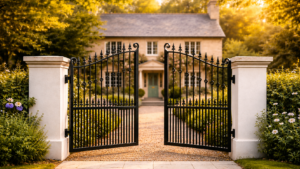

Driveway gates in London represent one of the highest-impact improvements a homeowner can make to their property. The right gate improves security, privacy, kerb appeal, and measurable property value simultaneously. The wrong gate, a catalogue product that does not fit the entrance, a cheap motor that fails in two years, a design that looks wrong on the property, does the opposite.
This guide covers everything a London homeowner needs to know before buying driveway gates in 2026: the types available, which suits which property, what the full installed cost looks like, how the planning position works across London boroughs, and what distinguishes a quality installation from a poor one.
Types of Driveway Gates Available in London
Swing Gates
Swing gates are the most common choice for London residential driveways and the starting point for most gate enquiries. Two leaves, hinged at each post, opening inward. The inward-opening configuration is standard because outward-opening gates risk obstructing the pavement under the Highways Act and require significantly more space in front of the gate line.
Swing gates suit driveways with sufficient depth behind the gate line for the leaves to open fully without hitting a parked car. For a pair of gates covering a 3-metre opening, each 1.5-metre leaf needs 1.5 metres of clear depth to open fully. For larger openings, the depth requirement increases proportionally.
Swing gates are available in electric or manual operation and in standard or bespoke designs. See our swing gates vs sliding gates guide for a full comparison.
Sliding Gates
Sliding gates move parallel to the boundary wall and need zero driveway depth to operate. For London properties with short driveways, tight set-backs, or entrances where swing gate clearance is not available, sliding gates are often the only practical solution.
A sliding gate requires clear wall space alongside the entrance opening for the gate to slide into when open. The gate leaf is typically 10 to 20 percent longer than the opening it covers, to allow for the overlap at the closed position and the motor bracket at the open end. A gate covering a 3-metre opening needs approximately 3.3 to 3.5 metres of clear wall space to retract into.
Sliding gates can run on a ground-level track or on a cantilever system with no ground track. See our sloped driveway guide for guidance on which sliding gate type suits which site.
Bi-Fold Gates
Bi-fold gates fold in half as they open, taking up approximately half the swing clearance of a standard swing gate leaf of the same width. They are the solution for properties where the driveway has some depth but not enough for full swing gate operation, and where lateral wall space for a sliding gate is also limited.
Bi-fold gates cost more than standard swing gates of the same width due to the additional folding mechanism, and they require a more complex motor configuration. They are the right choice for a specific subset of London sites rather than the default.
Manual vs Electric
Any gate type can be manual or electric. Electric driveway gates are operated by a motor controlled by a remote, keypad, intercom, or smart app. Manual gates are operated by hand.
For driveways used multiple times daily by drivers, the case for electric operation is straightforward. For occasional-use entrances or properties where the gate is primarily decorative, manual operation is a legitimate and more affordable choice.
See our electric vs manual gates guide for the full comparison.
Materials for London Driveway Gates
Steel
Steel is the most appropriate material for the great majority of London residential driveway gates. It suits Victorian, Edwardian, and Georgian period properties authentically, offers the widest design flexibility for bespoke fabrication, and when correctly specified with hot-dip galvanising and quality powder coat, requires minimal maintenance for decades.
The critical specification element is hot-dip galvanising. Powder coat applied over bare or primed steel looks identical to galvanised steel on day one but develops rust at weld points and cut edges within a few years in London’s urban environment. Always confirm galvanising is included in any steel gate quote.
See our steel vs aluminium gates guide for a detailed material comparison.
Aluminium
Aluminium gates are rust-free, lighter than steel, and hold powder coat finishes reliably. They suit contemporary new-build properties and are a reasonable choice where low maintenance is the primary concern. They are not typically appropriate for Victorian, Edwardian, or Georgian period properties in conservation areas, where conservation officers consistently prefer steel or period-appropriate materials.
Bespoke Fabrication
Bespoke metal gates are designed and fabricated to the specific measurements and requirements of a particular entrance. For London period properties with non-standard pier spacings, conservation area requirements, or visual standards that catalogue products cannot meet, bespoke fabrication is not a premium option, it is the only option that produces the right result.
Every gate NOVA Gates & Railings installs is fabricated in-house by our own team to the measured dimensions of the specific entrance. We do not supply catalogue products.Driveway Gate Costs in London 2026
| Gate Type | Typical Fully Installed Cost in London |
| Manual swing gates (pair, steel, standard) | £2,500 to £4,500 |
| Electric swing gates (pair, standard design) | £4,500 to £8,500 |
| Electric swing gates (pair, bespoke fabricated) | £7,000 to £14,000 |
| Electric sliding gate (standard) | £6,500 to £13,000 |
| Electric sliding gate (bespoke fabricated) | £9,000 to £16,000 |
| Bi-fold gates | £6,000 to £12,000 |
| Underground motor upgrade | Add £2,000 to £4,000 |
| Smart gate system with video intercom | Add £1,500 to £3,500 |
These figures include gate supply or fabrication, motor and control board, safety devices, electrical connection, groundworks and post foundations, commissioning, and safety compliance documentation.
For a full cost breakdown by gate type and what drives price in London specifically, see our driveway gates cost guide and electric gates cost guide.
Choosing the Right Gate for Your London Driveway
Do You Have Enough Depth for Swing Gates?
Measure from the gate line to the nearest obstacle behind it: the front wall of the house, the edge of a step, or the front of a parked car in its normal position. If this measurement is at least equal to half the total gate opening width, inward-opening swing gates are viable. If not, a sliding or bi-fold gate is the right direction.
See our short driveway guide for a complete decision framework.
Does Your Driveway Slope?
Sloped driveways change the gate specification significantly. A driveway that slopes up or down from the road creates clearance problems for swing gates and may require a sliding gate or cantilever sliding gate instead. See our sloped driveway guide for the full range of solutions.
What Is the Property Type?
Victorian, Edwardian, and Georgian properties need gates that respond to their architectural character. Catalogue gates in standard profiles look wrong on period properties, particularly where conservation areas apply. Bespoke fabrication and period-sympathetic design are the right approach for these properties. See our period homes driveway gates guide.
Are There Existing Gate Posts or Piers?
Many London period properties have original brick or stone piers that can be used for a new gate installation without replacement. Whether existing piers are suitable depends on their structural condition, foundation depth, and pier spacing. See our guide to electric gates with existing brick piers for a full assessment framework.
Planning Permission for Driveway Gates in London
Most residential driveway gate installations in London fall under permitted development and do not require a planning application, provided the gate is under one metre in height adjacent to a highway and under two metres elsewhere. The exceptions are:
Conservation areas. In some conservation areas, particularly those with Article 4 Directions, installing or changing a front boundary gate may require planning permission even within standard height limits.
Listed buildings. Any works affecting the character of a listed building or its curtilage require listed building consent. Check via Historic England’s listed buildings search.
See our full planning permission guide and the planning portal guidance on gates and fences.
We review the planning position as part of every free site survey.
Safety Requirements for Electric Driveway Gates
Under HSE guidelines for powered gate installations, all electric gates must include safety photocells, safety edges, force compliance testing at handover, and a manual release. These are legal requirements, not optional extras. An installer who does not include them is not providing a compliant installation.
NOVA Gates & Railings provides full EN 12453 safety compliance documentation on every installation.
Service Areas in London
NOVA Gates & Railings installs driveway gates across South West London and Surrey, including Wimbledon, Putney, Richmond, Kingston, Sutton, Chelsea, Fulham, Clapham, Wandsworth, Tooting, Raynes Park, Croydon, and all surrounding SW, KT, TW, and SM postcodes.
About NOVA Gates & Railings
NOVA Gates & Railings is a CAME-approved bespoke gate installer based in Wimbledon. Every gate is fabricated in-house by our own team to the measured dimensions of the specific entrance. We carry a 10-year structural warranty on all fabricated steelwork and provide full safety compliance documentation at handover.
Book a Free Site Survey
Call us on 020 7117 2642 or get in touch to arrange a free site survey.
NOVA Gates & Railings. Bespoke Driveway Gates. Wimbledon, London. CAME Approved. 10-Year Warranty.