
This is one of the most common questions we get asked on site surveys across South West London and Surrey: the homeowner has measured the driveway, looked at the slope, and convinced themselves that electric gates are not an option. The good news is that a sloped driveway almost never rules out electric gates. What it does is change which gate type is the right answer and getting that choice wrong on a sloped drive creates problems that a level driveway would never have.
This guide explains exactly how slope affects the gate specification, which solutions work for which slopes, and what to expect on cost. If you are on a hill street in Wimbledon, Richmond, Kingston, Belmont, Epsom, Esher, or Twickenham all areas where sloped driveways are a regular part of our site surveys this covers your situation specifically.
The Short Answer
A sloped driveway does not prevent electric gates. It changes the gate type. For most slopes, a sliding gate is the most practical solution. For mild slopes, swing gates can still work with the right specification. For very steep or uneven ground, a cantilever sliding gate solves problems that a tracked system cannot.
The slope direction matters as much as the degree of slope. The table below gives the quick framework the rest of this guide explains the reasoning behind each answer.
| Slope Direction | Degree | Best Solution |
| Driveway slopes up from road | Mild (under 5°) | Swing gates with adjusted geometry |
| Driveway slopes up from road | Moderate to steep | Sliding gate (tracked or cantilever) |
| Driveway slopes down from road | Mild | Swing gates with rising hinges or adjusted clearance |
| Driveway slopes down from road | Moderate to steep | Sliding gate (tracked or cantilever) |
| Driveway slopes across the entrance (cross fall) | Any | Cantilever sliding gate |
| Uneven or gravel surface at entrance | Any | Cantilever sliding gate |
Why Slope Is a Problem for Swing Gates
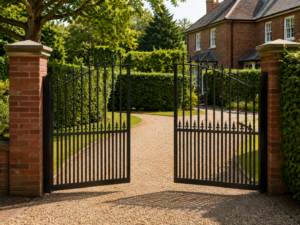
To understand why slope matters, it helps to understand how a swing gate moves. A swing gate opens on hinges fixed to a gatepost. The bottom edge of the gate traces an arc as it opens and that arc follows a horizontal plane. The ground underneath the gate is not horizontal if the driveway slopes.
On a driveway that slopes upward from the road (the gate opens away from the slope), the gate leaf sweeps into rising ground as it opens. The gap between the bottom of the gate and the ground increases at the far end and reduces at the near end. If the slope is significant, the bottom of the gate will hit the ground before it has opened fully. The standard fixes for this are either to raise the gate height at the lower end (reducing the security and aesthetic quality of the installation) or to reduce the gate height overall to maintain clearance, which compromises the gate’s proportions.
On a driveway that slopes downward from the road (the gate opens into falling ground), the gap issue is reversed the gate clears the ground easily but the gap at the lower end can become large enough to compromise the security and visual integrity of the installation. A person or animal can squeeze under a gate with a 200mm ground clearance. That gap is not a gap on a level driveway but it becomes one when the gate is hung to clear the high side of a downward slope.
A mild slope under approximately 5 degrees, which is a rise or fall of around 90mm over a 1-metre run can often be managed on swing gates with careful specification. Steeper than this and a sliding solution almost always produces a better result.
Solution 1: Sliding Gates The Most Reliable Solution for Sloped Driveways
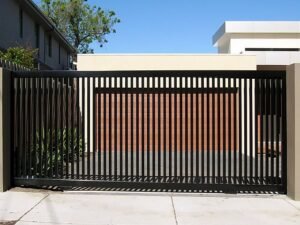
A sliding gate moves parallel to the boundary wall rather than swinging across the driveway. Because the gate moves sideways rather than arcing over the ground, the slope of the driveway does not affect its operation in the same way. The gate passes over the entrance opening at a fixed height as it slides, with no part of the gate sweeping across sloped ground.
There are two types of sliding gate relevant to sloped driveways: tracked and cantilever.
Tracked sliding gate. The gate runs on a ground-level track set into a channel at the base of the boundary wall. The track must be level even if the driveway surface is not which on a sloped driveway means the track channel is set into the slope at a constant height, with the driveway ramping away from it. This is standard practice and well within normal groundwork scope. The important limitation is that the track must be kept clear of leaves, grit, and debris on autumn streets with mature trees in Wimbledon, Richmond, Kew, and Twickenham, a tracked sliding gate track needs regular clearing during October and November.
Cantilever sliding gate. The gate is suspended from an overhead beam on posts at the side of the entrance, with no ground track. The gate slides along the beam without touching the ground at all. This completely eliminates the leaf debris and track maintenance issue and handles any degree of ground unevenness without modification. It also works on gravel driveways, cobbled surfaces, and any entrance where installing a ground track would be impractical or disruptive.
The trade-off for cantilever is that the beam needs to extend past the edge of the entrance opening on the opening side typically 60 to 80 percent of the gate width as a minimum. A 3-metre gate needs approximately 2 metres of clear wall space beyond the opening for the beam to retract into. Properties with a boundary wall that runs well past the entrance are ideal for cantilever. Properties with an entrance at the very end of a boundary wall, with nothing on the other side, cannot use cantilever.
Cost comparison on a sloped driveway: Sliding gate installation on a sloped driveway typically runs 15 to 30 percent higher than on a level driveway, because the groundwork for the track or beam foundation needs to account for the gradient. A standard tracked sliding gate installation in London on a sloped site: £7,000 to £13,000. Cantilever on a sloped site: £8,000 to £15,000. For full cost breakdowns, see our driveway gates cost guide.
Solution 2: Swing Gates With Rising Hinges
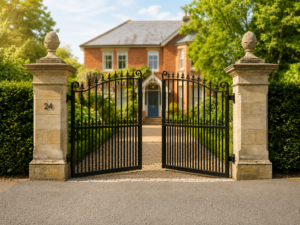
For mild slopes particularly on period properties in conservation areas across Richmond Hill, Kew Green, Wimbledon Village, Twickenham, or Cheam Village where a swing gate is the architecturally appropriate choice and a sliding gate would look wrong rising hinges offer a way to make swing gates work on a slope that would otherwise cause a clearance problem.
A rising hinge is designed so that the gate leaf lifts slightly as it opens typically 10 to 20mm of vertical rise over the opening arc. This rise compensates for ground that falls away as the gate swings. On a driveway with a gentle downward slope from the road, a rising hinge allows the gate to be set with a small clearance at the post end that increases to a comfortable clearance at the open position, rather than a wide gap at the post end that becomes an ungainly void when open.
Rising hinges are not a universal solution for steeper slopes. They are a precision engineering adjustment for mild gradients on properties where the swing gate profile is the right design choice. They are also relevant for properties where outward-opening gates are under consideration though outward opening gates have their own constraints under the Highways Act wherever the gate would open across a pavement.
Motor choice on sloped swing gates. Articulated arm motors can compensate for gradient better than underground motors on swing gates because the arm geometry adjusts more readily to the gate’s path on a slope. Underground motors produce the cleanest visual finish on level driveways, but on a sloped entrance an articulated arm motor is often the more reliable mechanical choice. This is one of the reasons underground motors, while popular on premium Richmond, Kew, and Wimbledon Village properties, are specified less frequently on sloped driveways even at the premium end of the market.
Solution 3: Cantilever Sliding Gates Best for Steep Slopes and Uneven Ground
Steep slopes above approximately 8 to 10 degrees, a rise or fall of around 150mm over a metre are difficult to solve with anything other than a cantilever sliding gate. At this gradient, neither a tracked sliding gate nor a swing gate produces a clean result. The track channel for a tracked sliding gate becomes difficult to form correctly, and a swing gate has an unmanageable clearance problem at either the post or the open position.
A cantilever gate suspended from an overhead beam sidesteps all of these issues because the gate does not interact with the ground surface at all. It slides along the beam at a fixed height regardless of what the ground beneath it is doing. On a steep hill driveway in Epsom, Belmont, Surbiton, Kingston Hill, or the elevated streets of Wimbledon Village, a cantilever gate is frequently the only specification that produces a gate that looks and works correctly.
Cantilever gates also suit driveways with a pronounced cross fall where the slope runs across the entrance rather than toward or away from the road. A cross fall creates an uneven surface that makes a level ground track very difficult to install, and creates a gap problem on one side of any swing gate. Cantilever solves both problems simultaneously.
What Happens at the Site Survey
When we carry out a free site survey on a sloped driveway, the first thing we assess is the direction and degree of slope, because this determines the gate type before any design conversation begins. We use a digital level and measure at multiple points across the entrance to get an accurate gradient reading rather than estimating visually.
For properties where a swing gate is the preferred architectural choice which comes up regularly on period properties in Wimbledon Village, Richmond Hill, Kew Green, and Twickenham we assess whether rising hinges or adjusted gate geometry can produce an acceptable result on the specific slope. Where the slope rules out swing gates entirely, we explain why and present the sliding or cantilever options in the context of the specific property.
The slope assessment also informs the groundwork specification. Steeper slopes require deeper, more carefully formed track or beam foundations to remain stable through London clay’s seasonal movement. We specify foundations for the actual ground conditions on site rather than using a standard template.
London and Surrey Areas With Commonly Sloped Driveways
Sloped driveways are part of the site survey landscape across the entire South West London and Surrey service area. Some specific areas come up repeatedly:
Wimbledon Hill and Wimbledon Village. The streets rising from Wimbledon town centre toward the Common, including Wimbledon Hill Road, Leopold Road, and the roads off them, have consistent gradients. Properties here frequently have sloped driveways ranging from mild to quite significant.
Richmond Hill. One of the steeper residential streets in the TW9/TW10 area. The houses on Petersham Road and the roads running off Richmond Hill toward the river have driveways where slope is almost always a design consideration.
Kingston Hill. The roads south of Kingston town centre toward Coombe have consistent upward gradients. Coombe Lane West and the estate roads on the Coombe Hill private estate regularly present sloped driveways on large plot properties.
Belmont, Sutton. The hillside streets of Belmont SM2 are some of the more pronounced gradients in the southern service area. Sloped driveways here are routine.
Epsom Downs. The streets south of Epsom town centre toward the Downs consistently slope. Properties on the roads toward Tattenham Corner and the Downs have driveways where cantilever is regularly the right specification.
Esher. Parts of Esher are notably elevated. The private roads off the High Street and toward Claremont include sloped entrances on premium properties.
Twickenham. The streets above Twickenham town centre rising toward St Margarets and the Richmond Park boundary include properties with sloped driveways that require careful specification.
Planning and Safety
A sloped driveway does not change the planning rules for electric gates the same permitted development heights apply (under two metres in height, under one metre adjacent to a highway) and the same conservation area and listed building considerations apply. See our planning permission guide for full guidance.
Under HSE guidelines for powered gate installations, all electric gates must include safety photocells, safety edges, and a force compliance test at handover regardless of whether the driveway is level or sloped. Safety edges on a sloped installation need to be set with ground clearance in mind a safety edge calibrated for a level surface may not trigger correctly where the ground is significantly lower at one end. We commission safety devices for the specific ground conditions on every installation.
About NOVA Gates & Railings
NOVA Gates & Railings is a CAME-approved bespoke gate installer based in Wimbledon, installing electric gates, driveway gates, swing gates, and bespoke metal gates on sloped and level driveways across South West London and Surrey.
We carry out site surveys on sloped driveways regularly across SW19, SW15, SW18, TW9, TW10, TW1, TW2, TW11, KT1, KT2, KT10, KT17, SM1, SM2, and surrounding areas.
Book a Free Site Survey
Call us on 020 7117 2642 or get in touch to arrange a free site survey. We assess the slope, explain the options, and give you a clear written quote no obligation.
NOVA Steels Gates & Railings. Bespoke Electric Gates for Sloped Driveways. Wimbledon, London and Surrey. CAME Approved. 10-Year Warranty.