This is a question that comes up on site surveys regularly, and it deserves a straight answer from someone who fabricates in steel every day.
Most content you find online about steel versus aluminium is written by companies that supply whichever material they happen to stock. The comparison tilts accordingly. We work primarily in steel, so we have an obvious bias, and we will be upfront about that from the start. What we will also do is tell you honestly where aluminium has genuine advantages, and where steel is the better choice for reasons that are not simply self-serving.
The short version: for most properties in South West London and the Surrey border, steel is the right material. For a specific subset of contemporary properties, aluminium is a viable and sometimes preferable alternative. The right answer depends almost entirely on what kind of property you have and where it sits.
What the Materials Actually Are
Steel driveway gates in London are almost always fabricated from mild steel, which is then hot-dip galvanised and powder-coated. Hot-dip galvanising is the process of immersing the fabricated steel in molten zinc at around 450 degrees Celsius. The zinc bonds metallurgically with the steel surface, creating a corrosion barrier that protects the steel even when the powder coat surface is subsequently scratched or chipped. The powder coat goes over the galvanised surface and provides the colour finish and additional protection. This combination is the standard specification for quality residential steel gates in the UK.
Aluminium driveway gates are fabricated from aluminium alloy sections, which are extruded or welded into gate frames and infill. Aluminium does not rust. It forms a natural oxide layer that prevents corrosion without the need for galvanising. The gate is powder-coated for colour in the same way as steel, but the underlying material requires no anti-corrosion treatment before coating.
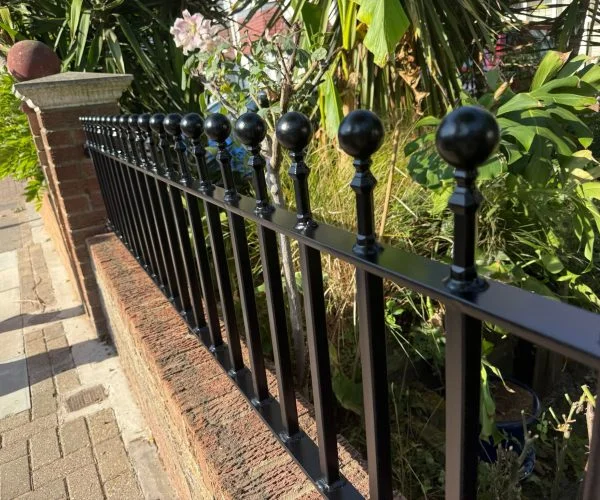
Wrought iron, which appears in a lot of content about London period property gates, is worth separating from mild steel. Genuine wrought iron is a hand-forged material that is no longer commercially produced for gate fabrication. Modern gates described as “wrought iron style” or “wrought iron effect” are fabricated in mild steel using techniques that replicate the aesthetic of hand-forged work. This is standard practice across the industry and produces results that are visually indistinguishable from genuine wrought iron to most observers.
Where Aluminium Has Genuine Advantages
Being honest about this section matters. Aluminium has real advantages in specific situations and dismissing them entirely would not serve you.
Zero maintenance requirement. Aluminium does not rust. If the powder coat is scratched or chipped, the underlying material is not compromised in the way that bare steel would be. There is no requirement to touch up chips promptly, no requirement for periodic inspection of the galvanised coating, and no risk of rust forming at weld points or cut edges if the surface treatment is imperfect. For a property where gate maintenance is unlikely to happen reliably, this is a genuine practical advantage.
Lighter weight. Aluminium is approximately one third of the weight of steel for an equivalent section size. A lighter gate puts less stress on the hinge fixings and the gatepost foundation. For properties with brick piers in marginal condition, or where the pier foundations are known to be shallow, a lighter aluminium gate reduces the structural demand on the existing boundary fabric.
No surface treatment before powder coating. Because aluminium does not require hot-dip galvanising before painting, the powder coating process is slightly simpler and the supply chain is shorter. This can reduce lead times on some standard-profile aluminium gates.
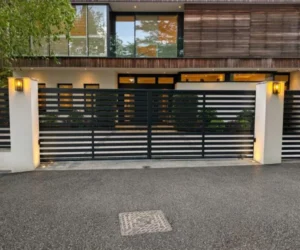
Contemporary aesthetic. Aluminium extrusions produce very clean, precise lines and tight tolerances that suit contemporary architectural styles. For flat-panel or horizontal slat gate designs on modern new-build properties, aluminium’s visual character is well suited.
Where Steel Has Clear Advantages
Design flexibility for bespoke fabrication. Mild steel can be cut, bent, welded, and shaped into virtually any profile. Scroll work, curved top rails, non-standard bar sections, finials of any design, and integration with cast iron-style ornamental details are all achievable in steel fabrication in a way that is simply not possible or practical with aluminium extrusions. For bespoke gates on London and Surrey period properties, where the design needs to respond to the specific character of the entrance and the architecture of the property, steel gives the fabricator a range of options that aluminium cannot match.
Period property authenticity. The original ironwork on Victorian, Edwardian, and Georgian properties across South West London and Surrey was cast iron or wrought iron, which is a ferrous metal. Aluminium was not used for domestic gate fabrication in any of these periods. A steel gate with period-appropriate detailing reads as belonging to a Victorian property in a way that an aluminium gate in the same profile does not, because the material itself has authenticity that aluminium cannot replicate. Conservation officers across London and Surrey consistently prefer steel over aluminium for period property gate installations.
Conservation area acceptance. This is the practical consequence of the point above. Our conservation area guide covers this in detail, but the consistent experience across the Merton, Wandsworth, Richmond, RBKC, and Elmbridge (Esher) planning authorities in our service area is that steel gates with period-appropriate profiles receive fewer design objections and require less justification in heritage statements than aluminium alternatives. On properties in the Wimbledon Village Conservation Area, Kew Green Conservation Area, Twickenham Riverside Conservation Area, or any of the Chelsea conservation areas, specifying steel is the materially lower-risk planning choice.
Long-term strength at heavy specifications. For larger gate openings, heavier gate leaves, and applications where the gate will be used many times daily over many years, steel’s greater tensile strength means the gate structure holds its geometry better over time. A large aluminium gate leaf can develop a slight flex in the frame under sustained use loading, particularly at the hinge corner. A steel gate of equivalent size is more rigid. For gates on private road estates in Esher, large residential driveways on Kingston Hill, or commercial-adjacent properties, this difference in structural behaviour matters.
Hot-dip galvanising provides exceptional long-term protection. The BS EN ISO 1461 standard governs hot-dip galvanising for structural steel, and the protection life in an urban UK environment is estimated at over 34 years before first maintenance is required on the zinc coating itself. The powder coat is the visible surface treatment; the zinc is the structural corrosion barrier underneath it. When a powder-coated aluminium gate sustains a chip, the underlying aluminium is exposed but does not rust. When a galvanised steel gate sustains a chip, the zinc layer sacrificially protects the underlying steel. In both cases the gate is protected, but the mechanisms are different and both are effective.
The Property-Type Matching Guide
The honest answer to “which should I choose” is almost always determined by the property. The following covers the main property types across our service area.
Victorian terraces and semis (South Wimbledon, Tooting, Clapham, Wandsworth, Raynes Park, Surbiton, New Malden, Sutton). Steel in all cases. The architectural character is wrong for aluminium, the conservation area risk is real on many of these streets, and the period-sympathetic railing and gate designs that look right on these properties require steel fabrication to execute correctly. See our period homes gates guide for the design principles by era.
Edwardian semis and detached houses (Wimbledon Park, East Sheen, Cheam, Kingston Hill, Twickenham). Steel strongly preferred. Edwardian properties share the same period-authenticity argument as Victorian, and the conservation area sensitivity is high across many of these addresses. Arts and Crafts-influenced Edwardian properties have a specific character that steel fabrication can respond to in a way that aluminium extrusions cannot.
Georgian and Regency properties (Richmond Hill, Kew Green, Twickenham Green, Chelsea, parts of Kingston Town). Steel only. Georgian properties sit in the most strictly managed conservation areas in the service area. The visual standard and the planning environment both require a material that has authenticity and design flexibility. Conservation officers in RBKC, Richmond, and Elmbridge have consistently preferred steel specifications on Georgian frontages.
Interwar and 1930s semis (Wimbledon Chase, Belmont, parts of Croydon, Coulsdon, Worcester Park). Steel or aluminium are both viable. Interwar properties were not built with original ironwork at the front boundary, so there is no period authenticity argument. The gate brief here is more practical: security, kerb appeal, and appropriate proportions for the property. Both materials work. Steel is still our recommendation for longevity and design quality, but aluminium is a reasonable choice if low maintenance is a priority.
Contemporary new-builds (Kingston riverside, Battersea Nine Elms, parts of Croydon town centre, Esher new developments). Aluminium is genuinely viable here and sometimes preferred. The flat-panel or horizontal slat gate designs that suit contemporary architecture are achievable in aluminium with clean, precise lines that suit the building style. There is no conservation area risk in most cases, and the low-maintenance argument is more relevant on a new-build where the owner does not want any surface treatment responsibilities.
Premium Surrey estate properties (Esher private roads, Claygate, Kingston Hill above the Coombe). Steel for bespoke specifications, which is almost always the right brief here. The gate openings are wide, the visual standard is high, the property values justify the premium specification, and the architectural character of large private-road properties in Esher and Claygate requires bespoke fabrication that only steel can deliver at the necessary quality level.
Cost Comparison
Material cost is one element of the total gate price, but the relationship between material and cost is not as simple as “aluminium costs more than steel” or vice versa.
For standard profile gates in fixed sizes, aluminium and steel are broadly comparable in material cost, with aluminium sometimes slightly higher for equivalent section sizes. The fabrication time is the bigger variable: a standard-profile gate in either material requires similar labour. A bespoke gate in steel that involves scroll work, curved rails, or non-standard profiles takes significantly more fabrication time than a standard aluminium profile, which is why bespoke steel gates cost more than standard aluminium gates. The comparison is not one material versus another at the same specification level. It is bespoke versus standard.
| Gate Specification | Typical Installed Cost in London and Surrey (2026) |
| Standard aluminium swing gates (pair) | £3,500 to £6,500 |
| Standard mild steel swing gates (pair) | £4,000 to £7,500 |
| Bespoke mild steel swing gates (pair) | £7,000 to £14,000 |
| Bespoke steel, conservation area specification | £9,000 to £20,000+ |
For full cost guidance by gate type, see our driveway gates cost guide.
Colour and Finish: Does the Material Affect the Options?
Both steel and aluminium can be powder-coated in any standard RAL colour. The colour choices available to the buyer are not affected by the material choice. The difference is in how the material holds the finish over time and how surface damage affects the underlying material, which has been covered above.
For guidance on colour selection by property type across South West London and Surrey, see our powder coating colours guide.
The Honest Recommendation
For the great majority of properties across our South West London and Surrey service area, steel is the right material. The housing stock is predominantly Victorian, Edwardian, and Edwardian-influenced, the conservation area presence is significant, and the design requirements of period properties favour a fabrication material that offers bespoke capability and period authenticity.
Aluminium is the right choice when low maintenance is the overriding priority, the property is contemporary and has no period architecture to respond to, and the gate design is a standard profile that does not require bespoke fabrication. On this subset of properties, we would recommend aluminium and say so clearly.
Where you are uncertain which applies to your property, the site survey is the right place to resolve it. A five-minute conversation at the entrance, looking at the property architecture, the conservation area position, and the gate brief, is more useful than any general guide.
About NOVA Gates & Railings
NOVA Gates & Railings is a CAME-approved bespoke gate installer based in Wimbledon, fabricating and installing electric gates, driveway gates, swing gates, and bespoke metal gates in steel for residential and commercial properties across South West London and Surrey.
Every gate is fabricated in-house in mild steel, hot-dip galvanised, and powder-coated to the client’s specified RAL colour.
Book a Free Site Survey
Call us on 020 7117 2642 or get in touch to arrange a free site survey.
We cover SW19, SW20, SW15, SW18, SW4, SW11, SW17, SW3, TW9, TW10, TW1, TW2, TW11, KT1, KT2, KT10, KT17, SM1, SM2, CR0, CR2, and surrounding areas.
NOVA Gates & Railings. Bespoke Steel Driveway Gates. Wimbledon, London and Surrey. CAME Approved. 10-Year Warranty.