The majority of properties in South West London are period homes. Victorian terraces, Edwardian semis, Edwardian detached houses, Georgian townhouses and villas these property types make up the housing stock across Wimbledon, Putney, Clapham, Richmond, Kingston, and the surrounding SW and KT postcodes.
They are also the properties where choosing the wrong gate causes the most visible and lasting damage to a frontage. A gate that does not belong on a Victorian terrace in Tooting or an Edwardian villa in East Sheen does not quietly blend in. It announces itself as wrong every time someone looks at the front of the house. And in a London property market where presentation drives value, that matters.
This guide covers what gates actually work on the three main period property types in London Victorian, Edwardian, and Georgian and why each requires a different design approach.
Why Period Homes Need a Different Approach
Before getting into each property type, it is worth being direct about why period homes in London require more thought than newer properties.
A contemporary new-build has no established architectural language at the front elevation that a gate needs to respond to. The designer has a relatively free brief. A period property is different. The materials, proportions, detailing, and character of the building were established in a specific era, and they communicate something to anyone who looks at the frontage. A gate that responds to that character looks as if it belongs. A gate that ignores it looks as if someone attached a catalogue product to a building they did not fully understand.
This is not about historical accuracy for its own sake. Most London homeowners do not want an authentic Victorian gate they want a gate that looks right on their Victorian house. The distinction matters because looking right is achievable with modern fabrication techniques and materials at a competitive cost, while historical accuracy with authentic materials is a specialist restoration brief at a significantly higher price.
What it does mean is that the gate cannot be chosen independently of the property. The pier spacing, the brick colour, the boundary wall height, the window proportions, the door style, and the condition and character of any surviving original ironwork on the property or the street all inform what a gate should look like. This is why bespoke fabrication produces better results on period London properties than catalogue gates in virtually every case.
Victorian Driveway Gates in London (1837 to 1901)
Victorian properties make up the largest share of period housing in South West London. The terraces of Clapham, Tooting, Wimbledon, Wandsworth, and Putney, the semi-detached houses of South Wimbledon, Norbiton, and Colliers Wood, and the larger villas of Richmond and Kingston Hill are all predominantly Victorian in origin.
Victorian architecture is characterised by decorative richness redbrick, terracotta details, elaborate bargeboards on the gabled versions, tile hanging, ornamental windows, and a general tendency toward embellishment that reflects the confidence and prosperity of the era. Victorian ironwork followed the same principle. Original gates and railings from this period feature spear or lance finials, scroll details at the foot rail, decorative panel infills on more expensive installations, and a visual weight that suits the character of the buildings they accompanied.
What works on a Victorian property:
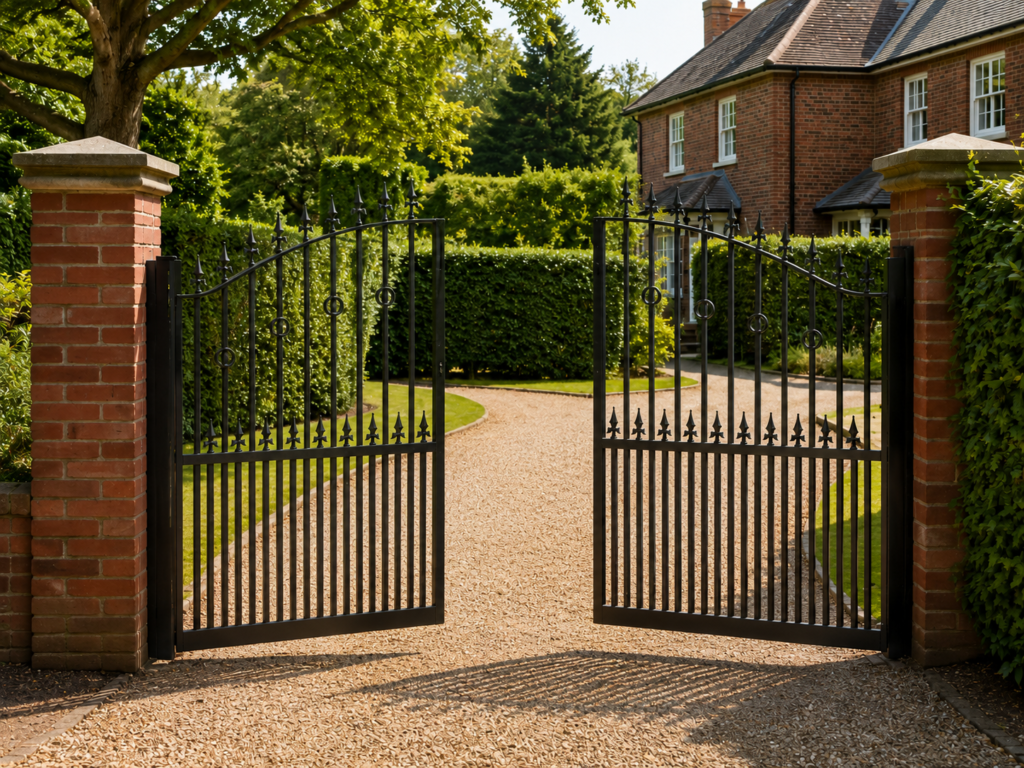
Vertical bar infill with spear or lance finials is the starting point for any Victorian gate. The infill bars should be appropriately spaced typically 90mm to 110mm centres and the finials should be of a height and profile that reads as period-sympathetic without being overtly theatrical. Scroll details at the bottom of the infill bars, where each bar meets the bottom rail, add character on more decorative Victorian gate designs without making the gate look out of place on a simpler terrace.
The top rail on a Victorian gate is typically curved either a single gentle arch across both leaves of a pair, or an individual arch on each leaf meeting at the centre. A flat top rail reads as more contemporary and tends to look wrong on Victorian properties, even when everything else about the gate is correct.
Black powder coat is the correct finish for Victorian gates in London. The original ironwork on Victorian London streets was black, and it remains the right choice for period-sympathetic replacements. Anthracite grey is increasingly popular as a contemporary alternative and works on some Victorian properties particularly those that have been significantly updated internally but on an unmodified Victorian redbrick terrace in Tooting or Clapham, black is the right answer.
What to avoid:
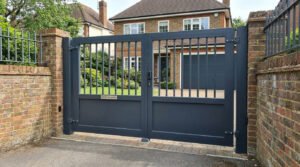
Flat panel gates in solid steel or aluminium read as contemporary and sit awkwardly on Victorian frontages. Horizontal slat gates popular on modern properties look particularly wrong. Gates that are proportioned incorrectly for the pier spacing, that sit too high or too low relative to the boundary wall, or that use finials of the wrong profile all create visual discord that is immediately apparent even to people who could not articulate exactly why.
Local examples:
Victorian terraces on the residential streets around Tooting Bec, the Victorian semis of South Wimbledon between the High Street and the Common, the terraced streets of Clapham Old Town and the roads off Clapham Common South Side, and the larger Victorian villas of Norbiton and parts of Kingston Town all represent the typical Victorian gate brief in the NOVA Gates & Railings service area.
Edwardian Driveway Gates in London (1901 to 1910)
Edwardian properties are the second most common period type in South West London. The Edwardian era saw a reaction against some of the heavier decorative excess of late Victorian design, moving toward simpler forms and an increased influence from the Arts and Crafts movement. Edwardian homes tend to have wider frontages than their Victorian predecessors the expansion of the suburbs in this period meant more land was available and they typically have more generous front gardens.
Edwardian architecture features white-painted timber joinery, bay windows, tile hanging on the upper floors of many designs, and in the grander examples of the type, half timbering on gables and porch details that echo the vernacular revival influences of the period. The ironwork that originally accompanied Edwardian properties tended to be somewhat simpler than high Victorian designs vertical bar infill with less scroll detailing, cleaner top rails, and lance rather than spear finials on many installations.
What works on an Edwardian property:
The wider frontages of Edwardian houses often mean larger gate openings than Victorian properties, which suits the proportions of a pair of gates that can be seen as a balanced composition across a wider entrance. Vertical bar infill remains the appropriate starting point. The detailing can be slightly simpler than on a high Victorian gate cleaner bottom rail profiles, lance rather than spear finials, less scroll work while still reading as period-sympathetic.
Arts and Crafts influence on some Edwardian properties particularly the larger Edwardian villas in Wimbledon Park, parts of Kingston Hill, and the premium Edwardian addresses in Cheam creates a specific brief where the gate design may need to respond to architectural details like decorative timber barge boards, stained glass porch windows, or tile hanging. In these cases a slightly more decorative gate design, possibly including panel infills or more elaborate finials, fits better than a very plain vertical bar design.
Black and dark green are both period-appropriate finishes for Edwardian gates. Dark green particularly RAL 6005 has historical precedent in the Edwardian period and suits properties adjacent to parks or with established mature gardens where a softer colour reads more naturally.
What to avoid:
Over-elaborate Victorian-style designs with heavy scroll work can look too busy on cleaner Edwardian frontages. The Arts and Crafts influence on Edwardian design valued simplicity and craftsmanship over decorative complexity, and a gate that reflects those values well-made, properly proportioned, with details that are considered rather than excessive is more appropriate than one that is trying to replicate late Victorian ornamentation.
Local examples:
Edwardian semis across East Sheen, the substantial Edwardian detached houses on the streets around Wimbledon Park, Edwardian villas in Kingston Hill and Cheam Village, and the Edwardian terrace streets of Surbiton and parts of New Malden represent the typical Edwardian gate brief in our service area. The John Innes estate in Merton Park, designed by Quartermain and Brocklesby between 1873 and 1926, is a specific example of Arts and Crafts-influenced Edwardian architecture where gate design needs particular care to match the character of the estate.
Georgian Driveway Gates in London (1714 to 1830)
Georgian properties are less common than Victorian or Edwardian across the wider South West London area, but they appear with high concentration in specific locations Richmond Hill, Richmond Green, Kew Green, parts of Kingston Town, and in Chelsea, Fulham, and the inner South West London streets that developed in the late 18th and early 19th centuries.
Georgian architecture is characterised by symmetry, restraint, and proportion. The Georgian aesthetic is one of rational order regular window spacing, balanced facades, classical detailing, and a palette of stone, London stock brick, and white-painted stucco that communicates stability and refinement. Original Georgian gates and railings in London were elegant and relatively simple by the standards of what came after vertical bar infill with lance finials, wrought iron construction, and a visual fineness that avoided the heavier profiles of the Victorian period.
What works on a Georgian property:
Simplicity and precision are the guiding principles. Vertical bar infill at regular spacing, lance finials of appropriate height, a refined top rail profile, and no scroll detailing or decorative panel infill. The gate should be exactly right in its proportions the pier spacing, the height relative to the boundary wall, and the balance of the composition when viewed from the street because on a Georgian frontage, proportion is everything and anything slightly off registers immediately.
White or off-white powder coat is the historically appropriate finish for gates on stucco-fronted Georgian terraces and villas. Black is also appropriate on brick-fronted Georgian properties. A gate on a Portland stone or stucco frontage in an incorrect colour particularly any shade of grey or brown creates a colour conflict that undermines the whole composition.
Conservation area and listed building considerations apply more commonly on Georgian properties than on any other period type. Many Georgian London properties are either listed or within strictly managed conservation areas where gate design and finish require pre-application advice or formal planning permission. The Historic England listed buildings search allows you to check whether your property or a neighbouring property is listed. See our planning permission guide for full guidance on what applies in conservation areas.
What to avoid:
Any decorative element that would not have been present in the original period. Scroll work, decorative infill panels, elaborate finials, and any element that reads as Victorian rather than Georgian all create a period mismatch on a Georgian frontage. The temptation to add decorative detail to make a gate look more elaborate is almost always wrong on a Georgian property. The design principle should be: remove one more element and see if the gate looks better. In most cases it does.
Local examples:
The Georgian streets of Richmond Hill and Richmond Green, the Georgian villas surrounding Kew Green, parts of Kingston Town close to the historic market centre, and the Georgian and Regency stucco terraces of Chelsea and Fulham represent the typical Georgian gate brief in and around our service area.
Conservation Areas and Listed Buildings: What You Must Know Before Ordering
This is not optional reading for period property owners. A significant proportion of London’s Georgian, Victorian, and Edwardian housing stock sits within conservation areas or is itself listed, and the planning implications affect gate specifications directly.
In conservation areas, replacing an existing gate with one of a different design, material, or colour can require a formal planning application even where the gate height falls within permitted development limits. The key question is not just whether a gate is technically permitted it is whether the local planning authority would consider the specific design appropriate for the conservation area character.
For listed buildings, listed building consent is required for any works affecting the character of the building or its curtilage, regardless of scale. A listed Victorian villa cannot have its gate replaced without consent, and the consent application will be assessed against the significance of the listed structure and the appropriateness of the proposed gate design.
The practical consequence for period property owners in London is that the gate design conversation should start with the planning position, not with a catalogue. An installer who does not raise the planning question for a period property in a conservation area is not giving you complete advice. We flag planning considerations as part of every site survey in our service area.
For full guidance on permitted development rules, conservation areas, and Article 4 Directions across London, see our planning permission guide.
Steel vs Timber for Period Gates in London
This question comes up regularly, and for London period properties the answer is almost always steel.
The original ironwork on Victorian, Edwardian, and Georgian London properties was cast or wrought iron a metal product, not timber. Timber gates have a place on certain rural or cottage-style period properties, but on the redbrick, terrace, and stucco properties of South West London they tend to look incorrect even when they are well made. Urban London’s weather pollution, variable moisture, and the general wear of a city environment also means that timber gates need considerably more maintenance than steel to remain in good condition. A hot-dip galvanised steel gate with a quality powder coat finish in the right colour is both the more authentic and the more practical choice for the great majority of London period properties.
For guidance on choosing the right material and finish for a London period property, including period-appropriate colour choices, see our metal railings guide and our guide to powder coating colours for London properties.
Matching Gates to Existing Railings
For period properties where front garden railings survive or are being installed alongside the gate, the relationship between the gate design and the railing design matters significantly.
The gate should read as part of the same family as the railing same infill bar profile, same finial design, same finish. A gate with one set of proportions and details next to a railing with entirely different proportions and details creates visual fragmentation that undermines both products. The solution is to design the gate and railing together from the outset, which is what we do on any project that involves both elements.
For period properties where sections of original railing survive on the property or adjacent properties, the surviving ironwork provides the design brief for both the gate and any new railing sections. Matching is the right approach. It restores the coherence of the original streetscape rather than adding to the patchwork of mixed-era treatments that characterises many London period streets. See our metal railings guide and bespoke railings service for more detail.
Cost of Gates for Period Homes in London
Period property gates in London almost always involve bespoke fabrication, and the cost reflects that. Standard catalogue gates in fixed sizes do not match the pier spacings of Victorian and Edwardian London properties, cannot be specified in the right design profile for the period, and produce results that are visually clearly wrong.
| Gate Type for Period London Home | Typical Installed Cost (2026) |
| Bespoke steel swing gates (Victorian/Edwardian) | £7,000 to £14,000 |
| Bespoke steel swing gates (Georgian, premium finish) | £9,000 to £18,000 |
| Period-sympathetic manual gates | £4,500 to £8,500 |
| Conservation area bespoke specification | £8,000 to £20,000+ |
For a full cost breakdown, see our driveway gates cost guide.
About NOVA Gates & Railings
NOVA Gates & Railings is a CAME-approved bespoke gate installer based in Wimbledon, designing and fabricating period-sympathetic driveway gates, bespoke metal gates, electric gates, and front garden railings for Victorian, Edwardian, and Georgian properties across London and South West London.
Every gate is designed and fabricated in-house by our own team. We do not use catalogue products. For period London properties where the design must respond to the specific character of the property and the street, in-house fabrication is the only way to produce the right result.
Book a Free Site Survey
Call us on 020 7117 2642 or get in touch to arrange a free site survey.
We cover SW19, SW20, SW15, SW4, SW11, SW17, SW18, TW9, TW10, KT1, KT2, SM1, SM2, and surrounding areas.
NOVA Steels Gates & Railings. Bespoke Gates and Railings for Period Homes. Wimbledon, London. CAME Approved. 10-Year Warranty.