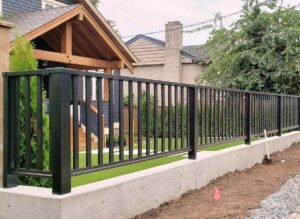

Metal railings are one of the defining features of London’s residential streetscape. The Victorian and Edwardian terraces that line the streets of Wimbledon, Clapham, Tooting, Putney, Richmond, and Fulham were built with cast iron front garden railings as standard. Much of that original ironwork was removed during wartime scrap metal collections in the 1940s and has never been adequately replaced. The demand for quality metal railings across London in 2026 reflects decades of accumulated replacement need on top of consistent demand from new installations, extensions, and renovation projects.
This guide covers everything a London homeowner or property manager needs to know about metal railings in 2026: the different types available, what they cost per metre, how to choose the right design for a period property, and what the planning position looks like across London boroughs.
Types of Metal Railings in London
Front Garden Railings
Front garden railings are the most common railing installation across South West London. They define the front boundary of a residential property at street level, providing security, boundary definition, and a visual quality that affects the kerb appeal and perceived value of the property.
The standard London period property specification is vertical bar infill with lance or spear finials, in black powder coat, at a height of 900mm to 1,100mm. This profile references the original Victorian cast iron that these properties were built with and sits correctly on a Georgian, Victorian, or Edwardian frontage.
Garden Railings
Garden railings covers boundary treatments on rear, side, or internal garden boundaries. These are usually less decorative than front elevations and can be specified more practically. Common applications include perimeter railings on rear gardens backing onto public land, side boundary treatments running alongside a passage or lane, and internal dividers between different areas of a larger garden.
Outdoor Railings
Outdoor railings is the broader category covering any external railing installation: stair and step railings for front or rear access, terrace and roof deck perimeter railings, ramp guard rails for commercial or public access, and any external railing where the primary function is safety at a change of level.
Steel Railings
Steel railings in the context of London property work almost always means mild steel fabricated sections, hot-dip galvanised and powder-coated. This is the appropriate specification for any outdoor railing installation in London’s urban environment. The galvanising process, governed by BS EN ISO 1461, bonds a zinc layer to the steel surface that protects the metal for decades even where the outer powder coat is scratched or chipped.
Bespoke Railings
Bespoke railings are designed and fabricated to the specific requirements of a particular installation. This is the appropriate approach where standard catalogue sections cannot accommodate the specific height, width, profile, or design required, which on London period properties with non-standard boundary wall heights, conservation area requirements, or surviving original ironwork to match, is frequently the case.
Metal Railing Costs in London 2026
| Railing Type | Cost Per Linear Metre Fully Installed |
| Standard steel, vertical bar, black powder coat | £150 to £220 |
| Steel with period detailing, decorative finials | £200 to £320 |
| Fully bespoke fabricated steel railings | £280 to £380 |
| Wrought iron-style restoration, period matching | £300 to £450 |
| Aluminium railings (contemporary) | £180 to £280 |
Typical project costs for a standard London Victorian terrace frontage (6 to 8 metres):
- Standard steel profile: £900 to £1,750
- Period-detail steel: £1,200 to £2,560
- Bespoke conservation area specification: £1,680 to £3,600
For a full cost breakdown including what drives price higher or lower on London properties, see our garden railings cost guide.
Choosing the Right Railing for Your London Property
Victorian Properties (1837 to 1901)
The most common property type across South West London for front garden railing installations. Victorian properties were built with cast iron railings featuring square or round vertical bars, spear or lance finials, and in the more decorative examples, scroll details at the bar foot and arched or curved top rails.
The standard replacement specification is mild steel vertical bar infill at 90mm to 110mm centres, with lance finials in black powder coat, at 900mm to 1,100mm height. Where original sections survive on adjacent properties on the same terrace, we take a direct profile measurement before fabricating new sections. See our period property matching guide for the full process.
Edwardian Properties (1901 to 1910)
Edwardian properties have slightly simpler railing profiles than high Victorian designs. Round bar infill is more common than square twisted bar. Lance finials are standard. The wider frontages typical of Edwardian properties suit a railing that is well proportioned for the plot width rather than simply replicating a terrace profile.
Georgian Properties (1714 to 1830)
Georgian railings in London were refined and precise: light vertical bars, fine lance finials, no scroll work, and typically in white or black depending on whether the frontage is stucco or brick. Georgian railings are more demanding to replicate well than Victorian because the proportions and the simplicity both need to be correct. Any excess weight or decoration looks wrong immediately against Georgian architecture.
Contemporary Properties
Contemporary new-build properties have no period ironwork to reference and the railing brief is determined by the architectural language of the building. Horizontal rail designs, flat square bar, and clean contemporary profiles in anthracite or other colours suit modern architecture. Aluminium is a viable material choice here where low maintenance is a priority.
For more detailed guidance on choosing the right design by period and property type, see our metal railings buyer guide.
The Importance of Hot-Dip Galvanising
This is the single specification element that most often separates a quality railing installation from a poor one, and it is the element buyers most frequently do not know to ask about.
Powder coat applied directly over bare or zinc-sprayed steel looks identical to hot-dip galvanised steel on the day of installation. Within three to five years, powder coat over bare steel will typically show rust at weld points, cut edges, and any area where the coat has been scratched. Powder coat over hot-dip galvanised steel can sustain chip damage and surface wear without rusting because the zinc layer underneath provides a sacrificial barrier.
The difference in longevity between the two specifications on a London front garden railing exposed to urban pollution, road salt, moisture, and physical contact over ten to twenty years is very significant. Always ask specifically whether a railing quote includes hot-dip galvanising and not simply zinc-spray primer or paint.
Metal Railings and Planning Permission
Most front garden railing installations in London fall under permitted development and do not require a planning application. The relevant height limits are under one metre adjacent to a highway and under two metres elsewhere.
The exceptions that commonly apply in London:
Conservation areas. In conservation areas, demolishing an existing boundary treatment or installing a new one that is visually different from the area’s character can require planning permission. The planning question in conservation areas is not just about height but about design appropriateness. See our conservation area guide for the full framework by borough.
Listed buildings. Listed building consent is required for any works affecting the character of a listed building or its curtilage. Check via Historic England’s ironwork guidance.
Article 4 Directions. Several London boroughs have Article 4 Directions that remove standard permitted development rights for boundary changes on specific streets. Wandsworth (11 Article 4 Directions), Merton (including Merton Park), and RBKC (100% borough coverage) are the most significant in our service area.
See our planning permission guide and the planning portal guidance on gates and fences for full national framework.
Front Garden Railings in Wimbledon
For guidance specific to Wimbledon SW19 and SW20 properties, including the four property zones across the postcode and their specific railing briefs, see our front garden railings Wimbledon guide.
Combining Railings With Driveway Gates
For properties that require both front garden railings and a driveway gate, designing both elements as a single coherent boundary project produces a far better visual result than specifying them separately. A gate whose infill bar profile, finial design, and colour matches the adjacent railing reads as a complete, considered boundary. A gate and railing from different sources in different profiles looks assembled rather than designed.
NOVA Gates & Railings designs and fabricates both railings and driveway gates as integrated boundary projects. See our gates and railings London service page for the full scope.
About NOVA Gates & Railings
NOVA Gates & Railings is a CAME-approved bespoke metalwork company based in Wimbledon, fabricating and installing metal railings, front garden railings, steel railings, garden railings, and bespoke railings for residential and commercial properties across South West London and Surrey.
Every railing is fabricated in-house, hot-dip galvanised to BS EN ISO 1461, and powder-coated in the client’s specified RAL colour. Made to measure as standard. 10-year structural warranty on all fabricated steelwork.
Book a Free Site Survey
Call us on 020 7117 2642 or get in touch to arrange a free site survey.
We cover SW19, SW20, SW15, SW18, SW4, SW6, SW11, SW17, SW3, TW9, TW10, TW1, KT1, KT2, SM1, SM2, CR0, CR2, and surrounding areas.
NOVA Gates & Railings. Bespoke Metal Railings. Wimbledon, London. CAME Approved. 10-Year Warranty.