
Being in a conservation area is one of the most common reasons homeowners across South West London and Surrey put off getting electric gates. The assumption is that it either cannot be done at all, or that the planning process is so complicated and uncertain that it is not worth starting. Neither of these assumptions is correct.
The truth is more straightforward than most people expect. Whether you need planning permission for electric gates in a conservation area depends on three things: the height of the gate, whether the property is listed, and whether an Article 4 Direction applies to your specific address. Most gate installations in conservation areas across London and Surrey fall under permitted development and require no planning application at all. The ones that do require permission almost always get it when the design is handled correctly.
This guide tells you exactly how to work out which situation applies to your property, what designs satisfy conservation officers, and what the process looks like when a planning application is genuinely needed
The Key Distinction: Conservation Area vs Article 4 Direction
These are two different things, and confusing them is the most common source of unnecessary anxiety about conservation area gate installations.
A conservation area is a designation that identifies an area of special architectural or historic interest. Being in a conservation area does not automatically remove your permitted development rights for gates. What it does is add a demolition-related requirement: in a conservation area, you need permission to demolish an existing gate, fence, or wall over one meter in height adjacent to a highway or over two meters in any other location. For a new gate installation where no existing structure is being demolished, the conservation area designation alone does not trigger a planning application requirement beyond the standard height rules.
An Article 4 Direction is a separate instrument that can remove specific permitted development rights for specific works in specific areas. Where an Article 4 Direction covers front boundary treatments in a street or area, it means that installing a gate or changing a boundary treatment may require a planning application even if the gate height is within permitted development limits and no demolition is involved. Article 4 Directions are common in conservation areas but are not the same as a conservation area designation and do not automatically accompany it.
The practical implication is this: being in a conservation area means you should check whether an Article 4 Direction also applies to your address. If it does not, the standard permitted development height rules apply. If it does, a planning application may be required regardless of gate height.
The boroughs in our service area with the most significant Article 4 Direction coverage relevant to gate and boundary installations include Wandsworth (11 Article 4 Directions across 46 conservation areas), Merton (including Merton Park Conservation Area with an Article 4 Direction endorsed by the Secretary of State), the Royal Borough of Kensington and Chelsea (100% borough coverage), and Richmond upon Thames. Surrey local authorities, including Elmbridge (covering Esher and Claygate) and Epsom and Ewell, have their own conservation area and Article 4 frameworks which differ from London borough rules.
The Standard Height Rules: What Is Permitted Development
Across most of England, including most of London and Surrey outside Article 4 Directions, driveway gates fall under permitted development provided:
The gate is no more than one metre in height where it is adjacent to a highway used by vehicles. In practice, this means the road in front of your property and the footpath alongside it.
The gate is no more than two metres in height where it is not adjacent to a highway.
Most residential driveway gates in London and Surrey are specified at between 1.6 and 1.8 metres in height, which exceeds the one-metre highway-adjacent limit. This means that for a gate at the front boundary of a property opening onto a public road, a planning application is required under the standard rules whether or not the property is in a conservation area. The conservation area designation does not make this worse. It is simply the standard height rule that applies to front boundary gates across the whole country.
What this means in practice is that the planning application for a typical front garden driveway gate is a routine application that planning departments across London and Surrey process regularly. It is not a complex heritage application. It is a standard householder application assessing whether the gate design is appropriate for its location. The vast majority are approved.
When a Planning Application Is Definitely Required
A planning application is required for a gate installation in a conservation area in any of the following situations:
The gate exceeds one metre in height at the front boundary adjacent to a highway. This applies across London and Surrey regardless of conservation area status.
An Article 4 Direction covers front boundary treatments for your specific address. The direction overrides the standard permitted development rights, making a planning application necessary for changes that would otherwise not require one.
The property is listed. Any works affecting the character of a listed building or its curtilage require listed building consent, regardless of gate height, conservation area status, or anything else. To check whether your property is listed, use the Historic England listed buildings search.
The gate involves the demolition of an existing structure. In a conservation area, demolishing a wall or gate over the relevant height thresholds requires conservation area consent before demolition proceeds.
What Gets Approved: Design Principles That Satisfy Conservation Officers
Understanding what conservation officers are looking for is more useful than memorising the planning rules. The planning rules tell you whether you need permission. What follows tells you what kind of gate gets permission when you need it.
Conservation officers across London and Surrey are applying the same fundamental test: does the proposed gate preserve or enhance the character of the conservation area? In practice, this translates into several consistent preferences that appear in pre-application advice and planning decision notices across the boroughs we work in.
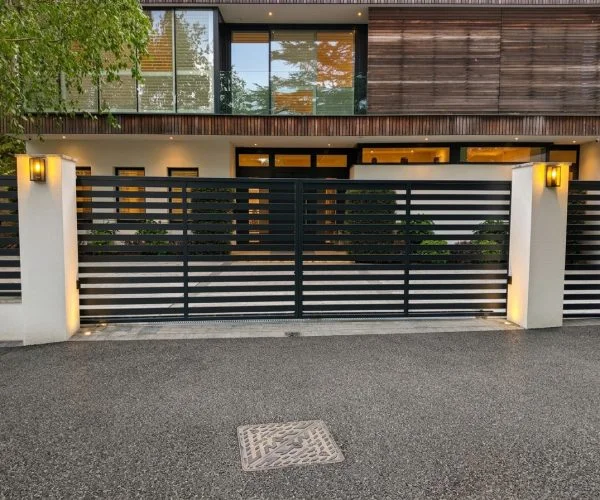
Period-sympathetic design is almost always preferred over contemporary design. A vertical bar steel gate with lance finials in black powder coat reads as having always been part of a Victorian or Edwardian conservation area street. A flat-panel contemporary gate in anthracite or a horizontal slat aluminium gate reads as a modern insertion. Conservation officers will approve both types in some circumstances, but period-sympathetic designs require less justification and more rarely attract objections from neighbours or amenity groups.
Steel is almost always preferred over aluminium. The original ironwork on London and Surrey period properties was steel or wrought iron. Aluminium is a modern material that does not appear in any pre-1950 context. Where a conservation officer has to choose between a steel gate with period detailing and an aluminium gate of equivalent design, the steel gate is easier to justify in a heritage assessment. For properties across Wimbledon Village, Richmond Hill, Kew Green, Twickenham, Esher, and Chelsea where conservation area appraisals specifically reference the character of original ironwork, steel is the clearly appropriate specification.
Gates should respond to the pier and boundary wall character. A gate that is proportioned correctly for the pier spacing, that sits at a height consistent with the adjacent boundary wall, and that has detailing that references the period of the property and its boundary features is far easier to approve than a gate that ignores the existing fabric. Conservation officers notice when a gate clearly has not been designed for the specific entrance.
Underground motors are sometimes preferred in sensitive settings. The visible mechanical component of an above-ground arm motor on a historic pier face can attract comment in conservation area planning assessments. Underground motors, which leave the post face completely clear with no visible mechanism, eliminate this issue. For properties in the most sensitive conservation areas, particularly in Chelsea (RBKC), parts of Richmond, Kew Green, and the Wimbledon Village Conservation Area, the underground motor specification can make the difference between a straightforward approval and a planning officer requesting design amendments.
For guidance on gate design by period property type, see our period homes gates guide.
How to Check Whether an Article 4 Direction Applies to Your Address
The fastest route is to contact the planning department of the local authority responsible for your property and ask specifically whether an Article 4 Direction applies to your address and covers front boundary treatments. Every London borough and Surrey local authority can answer this question. Many have online planning maps where Article 4 Direction boundaries are visible.
You can also apply for a Lawful Development Certificate. This is a formal decision from the council confirming that your proposed gate falls under permitted development and does not require a planning application. The fee is approximately £103 in most boroughs as of 2026, and the certificate provides written confirmation that protects you if the question ever arises at a later stage, including during a property sale. Where there is any doubt about whether an Article 4 Direction applies, a Lawful Development Certificate is worth obtaining before commissioning any fabrication.
We check the planning and Article 4 position for every address in our service area as part of the free site survey. For addresses where the position is not clear-cut, we advise on the appropriate route before any design or fabrication work begins.
The Planning Application Process When Permission Is Required
A standard householder planning application for a driveway gate in a conservation area across London and Surrey involves the following:
Pre-application enquiry. For addresses in particularly sensitive conservation areas, including RBKC, parts of the Wandsworth Old York Road Conservation Area, Merton Park, and the Wimbledon Village Conservation Area, a pre-application enquiry to the local authority planning team is worthwhile. This is an informal discussion of the proposed gate design with a planning officer before a formal application is submitted. It costs between £100 and £300 depending on the authority and typically returns useful feedback within four to six weeks. It is not mandatory but it significantly reduces the risk of a formal application being refused.
Application documentation. A householder application for a gate in a conservation area typically requires scaled drawings showing the proposed gate design in elevation and plan, photographs of the existing entrance and the surrounding streetscape, a supporting statement explaining how the design responds to the conservation area character, and in some cases a heritage impact assessment. We can provide the gate design drawings as part of the fabrication process, which can be submitted as part of the application alongside the installer’s conservation area assessment.
Determination period. Standard householder applications are determined within eight weeks. Conservation area applications occasionally take longer where the planning officer seeks additional consultation from heritage specialists.
What to do if refused. Refusals for gate applications in conservation areas are relatively rare when the design has been properly considered. Where a refusal does occur, it is almost always on design grounds rather than a categorical objection to electric gates in the conservation area. The design amendment required to resolve a refusal is usually straightforward. We have navigated this process across multiple conservation areas in the service area and can advise on what changes typically satisfy planning officers at appeal or resubmission.
Conservation Areas Across Our Service Area: What Applies Where
The planning framework varies significantly across the boroughs and Surrey authorities in our service area. The following covers the key differences.
Royal Borough of Kensington and Chelsea. The most restrictive planning environment in the entire service area. 38 conservation areas covering approximately 70% of the borough, around 3,800 listed buildings, and Article 4 Directions covering 100% of the borough’s land area. For any gate installation in Chelsea, assume a planning application is required until the specific address has been confirmed with RBKC. See RBKC conservation areas for appraisal documents. RBKC is also the authority where pre-application advice is most consistently valuable before committing to a design.
Wandsworth. 46 conservation areas, 309 listed buildings, 11 Article 4 Directions. The Magdalen Park Conservation Area in Earlsfield has an Article 4 Direction confirmed in 2023 covering front elevation changes. The Old York Road Conservation Area carries Article 4 Directions. Spencer Park conservation area covers the premium Victorian villa streets near Wandsworth Common. See Wandsworth conservation areas.
Merton. The Merton Park Conservation Area carries two Article 4 Directions endorsed by the Secretary of State. The Wimbledon Village, West Wimbledon, Wimbledon North, and Wimbledon Park Conservation Areas cover the main premium residential streets in SW19. See Merton conservation areas.
Richmond upon Thames. 72 conservation areas including Richmond Hill, Richmond Green, Kew Green, Petersham, and East Sheen Avenue. Article 4 Directions apply to a number of residential streets within the borough. The Kew Green Conservation Area is one of the most architecturally sensitive in the service area.
Elmbridge Borough Council (Esher, Claygate, Thames Ditton, Walton-on-Thames). Surrey county council’s planning framework applies rather than a London borough framework. Conservation areas in Elmbridge include Esher Village, Claremont, and several residential designations on the premium private road estates. The permitted development height rules are the same as London, but the Article 4 Direction coverage and conservation area appraisal standards differ. Pre-application advice from Elmbridge is generally faster to obtain than from the larger London boroughs.
Epsom and Ewell Borough Council. Conservation areas include Epsom Town Centre, Ewell Village, Stoneleigh, and several residential designations on the Epsom Downs slopes. The planning framework is Surrey-based, and the council’s heritage team can advise on specific address queries directly.
Practical Steps Before Commissioning a Gate in a Conservation Area
The right sequence for a conservation area gate project is straightforward.
First, establish whether the property is in a conservation area and whether an Article 4 Direction applies to your specific address and the works you are planning. Your local authority planning team can answer this directly, or we confirm it at the site survey.
Second, establish whether the property is listed. If it is, listed building consent is required and should be obtained before any design work is finalised.
Third, if a planning application is required, consider whether a pre-application enquiry is worthwhile before committing to a design. For addresses in the most sensitive conservation areas in the service area, this step saves time overall even though it adds to the timeline upfront.
Fourth, commission the gate design with the planning position established. A design that responds to the conservation area character from the outset is far less likely to require amendment than one produced independently of the planning context.
For the full national planning framework for gates and driveway boundaries, see our planning permission guide.
About NOVA Gates & Railings
NOVA Gates & Railings is a CAME-approved bespoke gate installer based in Wimbledon, designing and installing electric gates, driveway gates, bespoke metal gates, and front garden railings for residential and commercial properties across conservation areas throughout South West London and Surrey.
We carry out a planning position assessment as part of every site survey across the service area. For conservation area properties, this includes confirming the relevant authority, checking Article 4 Direction coverage, and advising on the appropriate planning route before any fabrication begins.
Book a Free Site Survey
Call us on 020 7117 2642 or get in touch to arrange a free site survey.
We cover SW19, SW20, SW15, SW18, SW4, SW11, SW17, SW3, TW9, TW10, TW1, TW2, TW11, KT1, KT2, KT10, KT17, SM1, SM2, CR0, CR2, and surrounding areas across South West London and Surrey.
NOVA Steels Gates & Railings. Bespoke Electric Gates for Conservation Area Properties. Wimbledon, London and Surrey. CAME Approved. 10-Year Warranty.