Choosing metal railings for a London home is one of those decisions that looks simple until you start looking into it properly. The material choice, the design profile, the height, the finish, the relationship to the property’s architecture and the surrounding street all of it matters, and getting it wrong produces a result that is visible from the pavement every single day.
This guide is written for London homeowners in 2026 who want to make an informed choice before approaching an installer. It covers the main material options, what suits different property types across South West London and inner London, how to match or replace original period ironwork, what the height and planning rules look like, and what quality metal railings should cost.
Steel, Wrought Iron or Aluminum – Which Is Right for Your London Home?
The material choice is the first and most important decision. Each option has a different look, a different cost, and different maintenance requirements, and the right choice depends almost entirely on the type of property you have.
Steel Railings – the Most Practical Choice for Most London Properties
Hot-dip galvanised mild steel with a powder coat finish is the most widely specified railing material for residential London properties in 2026, and for good reason.
Steel railings are stronger than wrought iron, consistently dimensioned because they are manufactured rather than hand-forged, and when galvanised and powder-coated properly they require virtually no maintenance for the life of the installation. The galvanising process involves immersing the fabricated railing in molten zinc, which bonds metallurgically with the steel and provides a corrosion barrier that paint alone cannot replicate. A quality powder coat finish over the galvanised base extends that protection further and provides the colour and finish.
For London’s urban environment pollution, variable weather, salt in the air closer to the Thames, and the general wear that comes from a busy city galvanized and powder-coated steel is the most reliable long-term material choice. It does not need annual painting, it handles mechanical damage (knocks from bins, bicycles, delivery vehicles) better than wrought iron, and it can be fabricated in almost any profile from a simple flat-bar vertical infill to a more decorative design with scroll details.
Steel is the right choice for the majority of Victorian, Edwardian, and interwar properties across Wimbledon, Clapham, Tooting, Putney, and Wandsworth, where the brief is to produce something that looks sympathetic to the period architecture without requiring the higher cost or maintenance of authentic wrought iron.
Wrought Iron Railings – for Heritage Properties and Authentic Period Restoration
Wrought iron is the original material for London’s residential railings. From the 17th century onward, the city’s Georgian, Regency, Victorian, and Edwardian terraces were originally fitted with hand-forged wrought iron railings, and the visual character of historic London streets Chelsea, Fulham, Kensington, parts of Clapham and Brixton owes a great deal to those original ironwork installations.
Modern wrought iron is not the same as the historic material. True wrought iron, with its fibrous slag-bearing structure, is no longer commercially produced in the UK. What is sold as wrought iron by most fabricators today is mild steel shaped to look like traditional wrought iron, sometimes combined with genuine recycled wrought iron sections for repairs.
For heritage restoration work replacing sections of original ironwork on a Georgian terrace, replicating the profile of surviving sections on a listed or conservation area property, or matching the railing character of a Chelsea or Fulham street where the original ironwork is still largely intact a fabricator with genuine knowledge of period profiles and hand-forging techniques produces a more authentic result than one working purely in mild steel.
According to the Westminster City Council railings guidance, wrought iron railings can be identified by their hand-beaten or rolled surface and the varying thickness that comes from hand-shaping. Cast iron railings, by contrast, are more massive in appearance and more repetitive in design because they were produced in moulds. Understanding which material the original railings were made from matters when specifying a sympathetic replacement.
The practical trade-off with wrought iron or wrought iron-style fabrication is cost and maintenance. It costs more to produce than standard steel fabrication and requires more periodic attention to prevent rust penetration, particularly on profiles with complex sections where moisture can accumulate.
Aluminium Railings – for Contemporary Properties and Low Maintenance
Aluminium is naturally corrosion-resistant and significantly lighter than steel or wrought iron. It suits contemporary and modern properties well clean lines, geometric profiles, and finishes that range from powder-coated colours to mill-finish aluminium.
For period London properties, aluminium is generally the wrong choice. It lacks the visual weight and character of steel or iron, and on a Victorian or Edwardian terrace it tends to look lightweight and out of place. Westminster City Council’s guidance notes that the Council does not recommend aluminium and soft alloys for listed buildings because they lack the appropriate character.
Where aluminium earns its place is on modern new-builds, contemporary extensions, rear terrace balustrades, and properties where the design is unambiguously contemporary rather than period. For these applications, its light weight is an advantage, it takes powder coat colours well, and the absence of rust risk makes it genuinely lower maintenance than steel.
Matching Original Period Ironwork – the Most Overlooked Part of the Brief
For London properties where original railings survive in part, or where adjacent properties on the same street have original ironwork still in place, matching or referencing that original profile is almost always the right approach.
This matters more in London than in most other cities because the streetscape continuity of London’s Victorian and Edwardian terraces is one of the defining visual qualities of its residential areas. A terrace of ten houses on a Clapham or Tooting street that shares the same railing profile, height, and finish character reads as a coherent whole. Introduce one set of railings in a completely different profile different bar spacing, different top rail detail, different height and it is immediately noticeable from the street.
There are three situations that commonly come up on London railing projects:
Bases survive, sections are missing. Many London terrace properties still have the original cast or wrought iron railing bases embedded in the boundary wall from the Victorian or Edwardian period. Where these are structurally sound and the historic interest of the property warrants it, a new railing designed to sit on those original bases in a compatible profile preserves the historic character while replacing the degraded or missing sections.
Adjacent properties have original sections. When sections of original ironwork survive on the property next door or elsewhere on the same terrace, that surviving ironwork is the design brief. A fabricator who takes a profile measurement and cross-section from the original will produce a replacement that integrates naturally with the existing streetscape.
Nothing survives but the period is known. For properties where original ironwork has been entirely lost, the architectural period of the property guides the profile choice. Georgian properties suit simple vertical bar railings with spear or lance finials. Victorian properties typically had more elaborate profiles with scroll details at the foot rail or decorative panel infills. Edwardian properties moved toward slightly simpler designs. An experienced fabricator will advise on appropriate period profiles for any London house type.
Railing Design – What Actually Determines How It Looks
Beyond the material, the design of the railing itself determines whether it looks right on your property or out of place. A few specific decisions matter most.
Bar spacing and profile
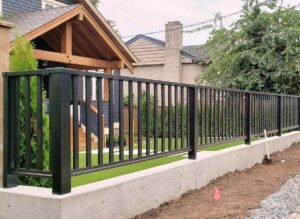
The vertical infill bars are the most visible element of any railing. Standard residential railing designs use 12mm square or 16mm square vertical bars at spacing of 100mm or 115mm. The maximum gap between bars for a railing where children might be present is 100mm this is a building regulation requirement for railings with a drop on one side and is worth understanding before finalising any specification.
Round bar profiles suit some contemporary and transitional designs. Twist profiles on bars add decorative character and suit period properties. Flat bar vertical infill is the most contemporary and minimal option, popular on modern London properties and rear extension balustrades.
Top rail and finials
The top rail profile and any finials at the top of the vertical bars have a significant effect on the character of the finished railing. Flat top rails read as contemporary. Rounded top rails are traditional. Spear top finials are the classic choice for period London properties. Ball finials are slightly less formal. Arrowhead or fleur-de-lis finials appear on more elaborate Victorian-style designs.
For front garden railings on period London properties, spear or lance finials at the appropriate height are almost always the right choice. For rear terrace balustrades and contemporary applications, a flat or minimal top rail suits the context better.
Height
Standard residential front garden railings in London run between 900mm and 1,200mm in height. Lower than 900mm looks insubstantial. Above 1,200mm starts to feel imposing on a standard terrace frontage.
For step railings alongside a front entrance staircase, the standard height follows the 1,100mm minimum handrail height requirement under building regulations when the railing serves as a barrier at a height change.
For rear terrace and balcony balustrades where the drop is above 600mm, the minimum height is 1,100mm under UK building regulations, and the railing specification must meet structural load requirements a minimum of 0.36 kN/m line load for residential applications. These are legal requirements, not design suggestions.
Powder Coat Colours Choosing the Right Finish for a London Property
The colour and finish of a metal railing affects how it reads on the property and the street more than most homeowners expect.
Black is by far the most common choice for front garden railings on London period properties, and for good reason. The original Victorian and Edwardian ironwork on London streets was almost universally painted black, and a black railing reads as contextually correct on these properties in a way that other colours simply do not. On a Georgian terrace in Chelsea or a Victorian semi in Clapham, black railings are the default choice.
Anthracite grey (RAL 7016) has become a popular alternative in recent years, particularly on properties that have been updated with modern windows, doors, or extensions. It reads as contemporary while still being a neutral, understated choice.
Green (RAL 6005) is the traditional colour for London park and garden railings. Kensington Gardens, Hyde Park, Regent’s Park are all green. On residential properties in areas adjacent to parks, a dark green railing can work well and has historical precedent.
White railings are a period-appropriate choice for Georgian and Regency properties, where white-painted ironwork was common. On a Regency stucco terrace in Chelsea or Notting Hill, white railings suit the architecture correctly.
All powder coat finishes should be applied over a hot-dip galvanised base coat for external metalwork. Powder coat alone without galvanising provides a shorter service life and is not appropriate for front garden railings in London’s outdoor environment.
Metal Railings for Different London Property Types
Victorian and Edwardian Terraces (Clapham, Tooting, Putney, Wandsworth, Wimbledon)
These are the properties where front garden railings most commonly need replacing, and where getting the profile and height right matters most for the streetscape. Steel with a galvanised and powder-coated finish in black is the standard specification. The design should reference the period vertical bar infill with spear or lance finials at 1,000mm to 1,100mm height. Where original railing bases survive in the boundary wall, building onto those rather than removing them preserves both the historic character and reduces the cost of the project.
Georgian and Regency Properties (Chelsea, Fulham, Kensington)
These properties often have their original ironwork partially or fully intact, and replacement work requires a higher level of care and design detail. Period-sympathetic profiles, matching finial designs, and, in some cases, hand forging or machining to replicate specific molded sections are part of the fabrication brief. Conservation area and listed building rules apply to many properties in these areas and should be checked before any work begins. See our planning permission guide for full guidance.
1930s and Post-War Semis (Surbiton, New Malden, Sutton, Croydon)
Properties from this period were rarely built with original front garden railings the interwar period saw a shift toward low walls and open frontages. A well-proportioned steel front garden railing on a 1930s semi in Surbiton or New Malden adds a boundary definition and kerb appeal that the property did not originally have but that suits it well. These projects are less architecturally constrained than period restoration work and the brief is typically practical and presentable rather than historically precise.
Contemporary New-Builds and Extensions
For modern properties and contemporary rear extensions, the railing brief is usually cleaner and more minimal horizontal infill options, flat bar sections, stainless steel accents, or aluminium for low weight on roof terrace balustrades. Powder coat colours can be bolder or more architectural. For roof terraces and external balustrades on extensions, the building regulation requirements for height and load capacity always apply.
Metal Railing Costs in London
Front garden railing installation in London typically costs between £150 and £380 per linear metre fully installed, depending on material, design complexity, height, and the condition of the existing boundary.
| Railing Type | Typical Cost Per Linear Metre (London 2026) |
| Standard steel, vertical bar, powder-coated | £150 to £220/m |
| Steel with decorative details, period profile | £200 to £320/m |
| Fully bespoke fabricated steel railings | £280 to £380/m+ |
| Aluminium railings (contemporary) | £180 to £280/m |
| Wrought iron style restoration work | £300 to £450/m+ |
A standard 6 to 8 metre front boundary run on a London terrace costs between £900 and £3,000 all in. Longer runs, decorative profiles, matching to existing sections, or conservation area work push the total up. Steps that incorporate a gate section alongside the main railing run also add to the total.
Planning Rules for Metal Railings in London
Most front garden railings in London fall under permitted development rights and do not require a planning application, provided the railing is under two metres in height (or one metre adjacent to a highway). The UK planning portal has the full guidance on what applies.
Exceptions apply for conservation areas and listed buildings, which are widespread across South West and inner London. If your property is in a conservation area, demolishing or replacing an existing front garden railing may require planning permission even if the new railing is the same height and material. Article 4 Directions in some London conservation areas remove permitted development rights entirely for front boundary changes. Check with your local planning authority before commissioning any work.
For listed buildings, listed building consent is required for any works affecting the character of the building or its curtilage. To check if your property is listed, use the Historic England listed buildings search.
For our full planning guide, see our planning permission guide for London driveway gates and railings.
What to Look for in a London Railing Installer
In-house fabrication. A company that designs and makes its own railings has control over quality and the ability to adjust a profile or detail during fabrication if something does not look right. A company that resells catalogue railings has less flexibility and less accountability when the finished product does not match expectations.
Hot-dip galvanising as standard. Any external steel railing in London should be hot-dip galvanised before powder coating. This is not an optional extra it is the correct specification for outdoor steelwork. If a quote does not mention galvanising, ask specifically.
Period property experience. For Victorian, Georgian, or Edwardian properties where the brief involves matching existing profiles or working within a conservation area, the installer needs to have done this kind of work before. Ask for examples.
HSE balustrade safety compliance for structural applications. For stair railings, terrace balustrades, and any railing with a drop on one side, the fabrication and fixing must meet building regulation structural requirements. Documentation should be provided at handover.
About NOVA Gates & Railings
NOVA Gates & Railings is a CAME-approved bespoke metalwork company based in Wimbledon, designing and installing metal railings, front garden railings, bespoke railings, garden railings, and outdoor railings for residential and commercial properties across London and South West London.
Every railing is fabricated in-house by our own team, hot-dip galvanised, and powder-coated to the client’s specified RAL colour. Made to measure as standard.
Book a Free Site Survey
Call us on 020 7117 2642 or get in touch through our contact page to arrange a free site survey.
We cover SW19, SW20, SW15, SW4, SW11, SW18, SW3, SW6, TW9, TW10, KT1, KT2, and surrounding areas.
NOVA Gates & Railings. Bespoke Railings and Gates. Wimbledon, London. CAME Approved. 10-Year Warranty.