
One of the most common questions we get after a gate installation is a variation of the same thing: how long is this going to last? It is a reasonable question for an investment that typically costs between £5,000 and £14,000 for a London residential installation.
The answer depends on which part of the gate you are asking about, because an electric gate is not a single product with a single lifespan. It is a system of components that each age at a different rate and fail in a different sequence. Understanding that helps you maintain the right things at the right time and budget for replacement costs sensibly rather than being surprised by them.
The Quick Answer
| Component | Typical Lifespan (well-maintained, London residential) |
| Gate structure (hot-dip galvanised steel) | 25 to 40+ years |
| Gate motor | 10 to 15 years |
| Control board | 10 to 15 years |
| Safety edges | 5 to 8 years |
| Photocells | 8 to 12 years |
| Video intercom | 8 to 12 years |
| Battery backup | 3 to 5 years |
The gate you install today should still be standing and functioning in twenty years if it is well specified, correctly installed, and properly maintained. The motor that came with it will probably need replacing once in that time. The safety edges will need replacing twice. The battery backup will need replacing three or four times.
None of these replacement costs are surprising if you know when to expect them. They become expensive when they are reactive rather than planned.
The Gate Structure: 25 to 40+ Years
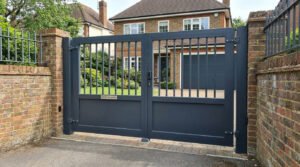
The fabricated steel gate itself is the longest-lived component in the system by a significant margin. A gate made from mild steel that has been hot-dip galvanised immersed in molten zinc to create a metallurgically bonded corrosion barrier and then powder-coated will last decades in an outdoor urban environment.
Hot-dip galvanising provides genuine long-term corrosion protection in a way that paint or zinc spray cannot replicate. The zinc layer bonds with the steel surface at a molecular level and corrodes sacrificially, meaning it protects the steel underneath even when the powder coat surface is scratched or chipped. The British Standards Institute estimates the performance life of hot-dip galvanising in an urban environment at 34 years before the first maintenance is required.
In practice, the limiting factor on gate structure lifespan is not the steel itself but the maintenance of the powder coat surface. Where chips and scratches are touched up promptly with matching paint, the underlying zinc protection remains intact and the gate lasts as long as the structure. Where chips are left untreated, moisture penetrates the coating and the zinc begins to perform its protective function creating a white powder residue visible around the chip until eventually, if left long enough, the zinc is consumed and rust starts.
London’s urban environment is harder on powder coat than rural locations. Road salt in winter, urban particulates, and the proximity of heavy traffic on many residential streets all contribute to surface wear. A gate on a quiet residential street in Wimbledon Village will hold its powder coat considerably longer than the same gate on a busy arterial road.
NOVA Gates & Railings provides a 10-year warranty on all fabricated steel structures. This reflects confidence in the specification hot-dip galvanising and quality powder coat applied correctly should comfortably exceed this period before any significant maintenance is needed.
The Gate Motor: 10 to 15 Years
The motor is the component most homeowners worry about first, and for good reason it is the most mechanically active part of the system and the one whose failure is most immediately disruptive.
A residential gate motor on a well-maintained gate, used a typical six to ten times per day, should give ten to fifteen years of reliable service. CAME residential motors are rated for 100,000 cycles, which at ten operations per day equates to roughly twenty-seven years but this theoretical maximum assumes perfect mechanical conditions throughout. In practice, London clay foundation movement, seasonal variation in gate weight as the structure absorbs or loses moisture, and the normal accumulation of hinge wear all mean that a motor is rarely operating in ideal conditions for its entire life.
The most important variable in motor lifespan is what the motor is actually working against. A motor pushing against a gate that runs smoothly on well-maintained hinges operates within a small fraction of its rated capacity. The same motor pushing against a gate with stiff hinges, a post that has moved slightly out of true, or a ground track full of debris is working at the upper limit of its capacity on every cycle. The latter case can halve or worse the effective lifespan of the motor.
This is why gate alignment and hinge maintenance matters so much. Most premature motor failures are not caused by a fault in the motor they are caused by a mechanical problem in the gate that was not addressed before the motor bore the consequences of it.
Signs a motor is approaching end of life:
- The gate moves more slowly than it used to, particularly in cold weather
- The motor is audibly louder during operation than when new
- The gate reverses more frequently for no apparent reason (the motor is detecting an obstruction that is actually just the increased effort of a gate running out of condition)
- The motor runs warm to the touch after normal operation
Motor replacement cost in London 2026: £800 to £1,800 for the motor unit, plus £300 to £600 for professional replacement labour. Total £1,100 to £2,400 depending on motor specification and site access.
The Control Board: 10 to 15 Years
The control board the electronics unit that interprets commands from remotes, keypads, intercoms, and smart systems, and sends the correct signals to the motor typically matches the motor in lifespan. Both are affected by the same environmental factors: temperature cycling, moisture exposure, and the cumulative effect of power fluctuations over years.
Control boards in London face a specific risk from voltage spikes during autumn and winter storms, which can damage sensitive electronics. A surge protector on the gate’s mains supply is a sensible addition that costs £30 to £80 and can prevent a control board failure that costs ten times that.
The most common cause of premature control board failure is moisture ingress into the control box housing. This is almost always caused by a deteriorated seal on the box lid or a cable entry point that was not properly sealed at installation. Inspecting control box seals annually and replacing them at the first sign of deterioration is the single most cost-effective preventative step for this component.
Control board replacement cost in London 2026: £400 to £900 for the board, plus installation labour. For CAME systems, CAME-approved installers can source genuine replacement boards. Third-party replacement boards are available at lower cost but may not be compatible with all motor configurations.
Safety Edges: 5 to 8 Years
Safety edges are the rubber or PVC pressure-sensitive strips fitted to the leading edge of the gate leaf. When the gate meets an obstruction a person, a vehicle, a bicycle the safety edge compresses and sends a signal to the control board to stop and reverse. They are a legal requirement under HSE guidelines and the EN 12453 safety standard.
Safety edges are consumable components. They degrade through UV exposure, repeated compression cycles, and weathering, and their sensitivity reduces over time even when they appear visually intact. A safety edge that looks fine but has lost the elasticity to compress fully at its edges is not detecting correctly at those points.
Unlike many gate components, a safety edge can fail while appearing to work correctly. A damaged edge that still responds in its central section but not at its corners looks fine to a casual visual inspection but leaves a physical gap in the safety coverage of the gate. Proper testing requires applying measured force at multiple points along the edge and confirming the gate stops and reverses each time this is the force compliance test that should be part of every annual professional service.
Safety edge replacement cost in London 2026: £80 to £180 per edge including labour. Most gates have one edge per leaf. Replacing at the annual service rather than waiting for a failure is the right approach.
Photocells: 8 to 12 Years
Photocells are the infrared beam sensors, one mounted on each gate post, that detect a person or object in the gate’s path when it is moving and stop the gate immediately. They are simpler than safety edges in their mechanism they either detect the beam or they do not but they degrade through UV exposure to the lens and through gradual drift in the electronic sensitivity of the sensor unit.
The most common photocell faults in London are lens contamination (dust, bird droppings, spider webs) causing false triggers, and winter sun angle causing the low-angle sunlight to interfere with the beam detection. Both of these are maintenance issues rather than end-of-life failures and should be addressed as they arise rather than assumed to indicate a photocell that needs replacement.
True end-of-life photocell failure is characterised by intermittent or persistent failure to detect the beam even after cleaning and alignment, or a sensitivity that cannot be adjusted to produce reliable performance. At this point replacement is the right decision.
Photocell replacement cost in London 2026: £120 to £280 per pair including labour.
Video Intercom: 8 to 12 Years
Video intercoms are electronic products and they age at the rate of consumer electronics rather than mechanical engineering. The camera sensor, the display if there is a monitor unit, and the digital processing components all have finite lives that are shortened by outdoor exposure, particularly in London’s wet winters.
CAME intercom systems installed alongside gate motors as a complete package tend to have good longevity because they are specified for outdoor gate use. Consumer-grade intercoms from general electrical suppliers are sometimes installed on gates as a cost saving and tend to have shorter outdoor lives.
The most common intercom failure modes are camera image degradation (the image becomes dark or blurred as the lens or sensor ages), audio quality deterioration, and connectivity failures on Wi-Fi integrated units as the wireless module ages. None of these require full intercom replacement immediately individual components can often be replaced but plan for a full intercom replacement somewhere in the 8 to 12 year window.
Intercom replacement cost in London 2026: £400 to £1,200 depending on specification.
Battery Backup: 3 to 5 Years
The battery backup is the shortest-lived component in the system and the one most commonly ignored until it fails. Most CAME motor systems use a sealed lead-acid or gel battery mounted inside the motor housing. It maintains a charge continuously from the mains supply and powers the gate automatically during a power cut.
Battery backup units degrade with each charge cycle and with temperature exposure. In a London environment where the motor housing experiences temperatures from close to zero in winter to well above ambient in a warm summer, batteries at the shorter end of the 3 to 5 year range are common.
Testing the battery is simple: turn off the mains supply to the gate at the consumer unit and confirm the gate still opens and closes normally on battery power. If it does not, the battery needs replacement. This test should be done annually as part of the autumn checklist ideally before the first power cuts of the winter season.
Battery replacement cost in London 2026: £50 to £150 for a standard residential gate battery. This is a component a confident homeowner can replace themselves on most CAME systems with basic tools and the motor manual.
The Repair vs Replace Decision
When a component fails on a gate that is more than ten years old, the question of whether to repair or replace the component requires a broader assessment of the overall system condition.
Replacing a motor on a gate whose control board is also ten years old, whose safety edges are overdue, and whose intercom is starting to show image degradation is a sequence of individual repairs that adds up to more than a complete system refresh. In this situation it is worth getting a professional assessment of the whole system rather than replacing components one at a time.
The gate structure itself if it is hot-dip galvanised steel that has been maintained is almost never the reason for a system replacement. The steel outlasts everything else by decades.
About NOVA Gates & Railings
NOVA Gates & Railings is a CAME-approved gate installer based in Wimbledon, installing and maintaining electric gates, swing gates, and smart gates across London and South West London.
All NOVA Gates & Railings installations carry a 10-year warranty on the fabricated steel structure and are installed to EN 12453 safety compliance with full documentation at handover.
For our complete seasonal maintenance guide, see our annual maintenance checklist for London homeowners.
For installation costs, see our electric gates cost guide and driveway gates cost guide.
Book a Free Site Survey
Call us on 020 7117 2642 or get in touch to arrange a free site survey.
We cover SW19, SW20, SW15, SW4, SW11, SW17, SW18, TW9, TW10, KT1, KT2, and surrounding areas.
NOVA Gates & Railings. Bespoke Electric Gates and Railings. Wimbledon, London. CAME Approved. 10-Year Warranty.