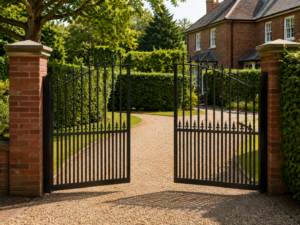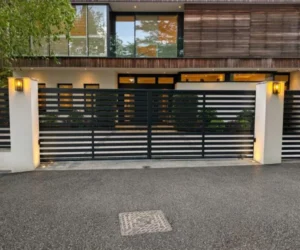

A security gate is a different product from a standard driveway gate, even when the two look superficially similar from the road. The difference is in the materials, the hinge and locking specification, the motor duty cycle, and in some cases a formal security rating that has been independently tested against forced attack. This guide explains what actually makes a gate secure, what the relevant standards mean, and what you should expect to pay for a genuinely secure installation in London in 2026.
What Makes a Gate a “Security Gate”?
Any electric gate provides a degree of security simply by being closed and locked. A security gate goes further. The term describes a gate that has been specifically designed and constructed to resist forced entry, whether that means a vehicle ram, a manual climbing or levering attempt, or a determined attack with hand tools.
The features that distinguish a security gate from a standard residential gate include heavier gauge steel in the gate panels and frame, reinforced hinges that cannot be easily lifted off or sheared, a locking mechanism with multiple engagement points rather than a single latch, anti-climb design features such as reduced foothold spacing or angled toppers, and in commercial or high-security applications, a formal third-party security rating.
For most London homeowners, “security gate” describes a gate built to a meaningfully higher specification than a standard decorative driveway gate, without necessarily carrying a formal independent certification. For commercial properties, schools, and high-value residential sites, formal certification becomes relevant and is covered below.
LPS 1175: The Security Rating Standard Worth Understanding
LPS 1175 is the UK’s leading test standard for security products including gates, fencing, doors, and grilles. It is administered by the BRE Group and works by subjecting a product to a timed physical attack using a defined toolkit, with the product rated according to how long it resists entry.
The standard has multiple security ratings, broadly running from lower ratings suitable for opportunist deterrence through to higher ratings tested against sustained attack with power tools, designed for high-value commercial and government sites. For residential applications, an LPS 1175 rated gate is generally reserved for higher-value properties or sites with a specific elevated risk profile, because the cost of a fully certified product is significantly higher than a well-built but uncertified security gate.
For the majority of London residential security gate projects, formal LPS 1175 certification is not necessary or proportionate. What does matter is that the gate is built using the same principles the standard tests for adequate material gauge, properly reinforced fixing points, and a locking system that cannot be defeated with basic tools. A good fabricator builds to these principles as standard practice even without third-party certification, and you should ask directly whether they do.
Secured by Design, the UK police initiative supporting crime prevention through design, is also relevant for some projects, particularly new-build developments and properties where compliance with police-preferred specifications is part of a wider security or insurance requirement.
Security Gates for Residential London Properties
For most homeowners, the brief is a gate that looks appropriate for a residential frontage while genuinely resisting casual forced entry not a fortified compound entrance, but a gate that does its job properly.
The material specification matters most here. Standard residential driveway gates are commonly fabricated from 25mm to 40mm box section steel. A genuine security specification steps up to 50mm or 60mm box section for the main frame, with closer infill bar spacing to reduce climbing footholds and prevent gaps large enough to reach through.
Hinges are the most commonly underspecified part of a security gate. A standard hinge can be defeated by lifting the gate off the pin if it is not properly secured. Security hinges use anti-lift pins, welded collars, or concealed hinge designs that cannot be separated without cutting.
The locking mechanism on a security gate should engage at multiple points along the gate leaf rather than relying on a single latch at one corner. For electric gates, the motor itself, properly specified, acts as a locking mechanism when closed, since a quality gate motor cannot be forced open by hand without specialist tools, but a mechanical deadlock as a backup is good practice on a genuine security installation.
For London properties where security gates are most commonly specified return visits from previous attempted break-ins, properties backing onto alleys or unmonitored land, high-value properties, or commercial premises adjoining residential streets the combination of heavier gauge material, reinforced hinges, and a quality motor with backup locking covers the great majority of realistic risk.
Security Gates for Commercial London Properties
Commercial security gate requirements differ from residential in both scale and duty cycle. A commercial gate at a business premises, school, or industrial site in London may open and close dozens or hundreds of times per day, every working day, for years. The motor and mechanical specification needs to be built for that level of use, not adapted from a residential product.
Commercial security gates typically use higher duty cycle motors rated for continuous or near-continuous operation, heavier gauge steel construction throughout, and in many cases integration with wider access control systems including card or fob readers, ANPR for vehicle fleets, and connection to a central building management or security system.
For schools specifically, security gate specifications increasingly need to account for child safeguarding requirements alongside physical security controlled pedestrian access points separate from vehicle gates, anti-trap safety features that meet both security and child safety standards simultaneously, and often a requirement for Secured by Design compliance as part of the wider site security plan.
For industrial sites, warehouses, and distribution centres across London, LPS 1175 rated gates become genuinely relevant, particularly where insurance requirements or the value of goods on site justify the additional cost of certified products.
Security Gate Costs in London
Costs vary significantly between a residential security specification and a fully rated commercial product.
| Gate Type | Typical Installed Cost in London (2026) |
| Residential security gate (heavy gauge, reinforced, standard motor) | £5,500 to £11,000 |
| Residential security gate with underground motor and ANPR | £9,000 to £16,000 |
| Commercial security gate (standard duty cycle) | £8,000 to £15,000 |
| Commercial security gate (high duty cycle, heavy-duty automation) | £12,000 to £22,000+ |
| LPS 1175 rated gate (commercial/industrial) | £15,000 to £30,000+ |
These figures reflect London labour rates and the bespoke fabrication that most genuine security specifications require security gates are very rarely an off-the-shelf catalogue product because the brief is so specific to the site. For a full breakdown of standard electric gate costs by type, see our driveway gates cost guide.
Security Gates and Smart Access Control
A security gate is most effective when paired with proper access management rather than relying on the gate’s physical strength alone. Smart gate systems with app control, GSM connectivity, and activity logging allow a homeowner or facilities manager to know exactly who has accessed the property and when, which is a meaningful security layer in its own right.
For higher-security applications, ANPR automatically logs and controls vehicle access without manual intervention, removing the human error risk of a shared code or fob being passed on inappropriately. Video intercom integration means no visitor gains access without visual verification first. See our full smart gates guide for the technical detail on how these systems work.
Swing or Sliding for a Security Installation?
Both gate types can be specified to a security standard, but they have different security characteristics worth understanding.
Sliding gates, when closed, typically lock into a cradle or guide fitting at the receiving post, which creates a strong single point of engagement that is mechanically difficult to force without specialist equipment. This makes sliding gates a common choice for higher-security commercial applications.
Swing gates rely on the strength of the hinge and the locking mechanism at the meeting point of the two leaves, or at the single leaf and the receiving post for a single gate. A well-specified swing gate with reinforced hinges and a quality deadlock is entirely adequate for residential security applications, and remains the more common choice for London homes because of the visual character and the lower groundwork cost.
For a full comparison of how each gate type works and which suits different driveways, see our swing gates vs sliding gates guide.
Safety Compliance Still Applies
It is worth being clear that a security gate is still subject to the same legal safety requirements as any other electric gate. Under HSE guidelines for powered gate installations, every electric gate, regardless of how heavy-duty or security-focused the specification, must include safety photocells, safety edges, and a force compliance test before handover. A gate that is secure against forced entry but unsafe in normal operation is not an acceptable installation, and any professional installer will build both requirements into the design from the outset.
What to Ask Before Commissioning a Security Gate
What gauge steel is being used, and is it heavier than a standard gate of the same size? A genuine security specification should be visibly and measurably more substantial than a standard decorative gate.
How are the hinges secured against lifting? Ask specifically about anti-lift features. This is the most commonly overlooked weak point on gates marketed as security products without the detail to back it up.
What is the locking specification, and does it include a mechanical backup to the motor? A motor alone, however good, should not be the only thing standing between the gate and forced entry.
Is the gate being designed and fabricated in-house, or supplied from a third party? For a genuinely bespoke security specification matched to your specific risk profile and site, in-house fabrication gives the installer full control over every detail of the build.
Is LPS 1175 certification relevant to this project, and if not, why not? For most residential projects the answer will be that it is not proportionate, but a knowledgeable installer should be able to explain that reasoning rather than simply not raising the topic.
Planning Permission for Security Gates
Security gates follow the same planning rules as standard driveway gates in London generally permitted development under two metres in height, or one metre adjacent to a highway, subject to conservation area and listed building exceptions. For full guidance, see our planning permission guide for London driveway gates.
About NOVA Gates & Railings
NOVA Gates & Railings is a CAME-approved gate and railing installer based in Wimbledon, designing and fabricating security gates, electric gates, and driveway gates for residential and commercial properties across London and South West London.
Every gate we install is fabricated in-house by our own team to the exact specification required for the site, whether that is a discreet residential security upgrade or a heavy-duty commercial installation.
Book a Free Site Survey
Call us on 020 7117 2642 or get in touch through our contact page to arrange a free site survey.
We cover SW19, SW20, SW15, SW4, SW11, SW17, SW18, TW9, TW10, KT1, KT2, and surrounding areas.
NOVA Gates & Railings. Bespoke Security Gates and Railings. Wimbledon, London. CAME Approved. 10-Year Warranty.