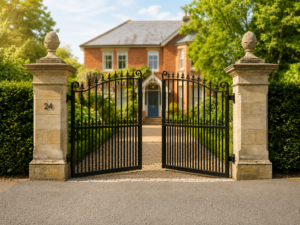
The most common planning-related question we get on site surveys across South West London is some version of this: do I need permission for this?
Most residential driveway gate installations in London do not require planning permission. They fall under permitted development rights, which are a legal grant of permission written into national legislation, the Town and Country Planning General Permitted Development Order 2015 that allows certain types of work to be carried out without a formal planning application.
But the short answer only gets you so far. London has a significant number of conservation areas, listed buildings, and its directions can change the picture for specific properties. And getting this wrong has real consequences enforcement action, a requirement to remove the gate at your own cost, and complications when you sell the property.
This guide gives you a clear, practical answer to the planning permission question for driveway gates and electric gates in London in 2026. What the rules are, when they apply, what the exceptions look like, and what to do when you are not sure.
The Permitted Development Rules for Driveway Gates in London
Under theUK planning portal guidance on gates, fences and walls, driveway gates fall under permitted development rights provided all of the following conditions are met:
The gate is no more than 1 metre in height if it is adjacent to a highway used by vehicles (which includes the road in front of your property and the footpath alongside it).
The gate is no more than 2 metres in height in any other location on your property.
The property is not a listed building and the gate is not within the curtilage of a listed building.
No it Direction has removed permitted development rights at your specific address.
If all four conditions are met, you can install a driveway gate without a planning application. For the vast majority of standard residential properties in South West London with standard gate heights, this is the position.
The 1 Metre Rule: What It Actually Means
The 1 metre height limit for gates adjacent to a highway causes more confusion than any other part of the planning rules, and it is worth being clear about what it means in practice.
The rule applies when the gate is adjacent to a highway. A highway includes not just the carriageway but the footpath alongside it. So if your gate is set back from the road by a metre or more, it may no longer be adjacent to the highway and the 2 metre limit may apply instead. But if your gate sits immediately at the boundary with the pavement, the 1 metre limit applies.
Here is the practical implication. Most standard residential swing gates and electric driveway gates in London are installed at heights between 1.2 and 1.8 metres. A 1.8 metre gate is the most common residential specification. That gate is above the 1 metre limit for a highway-adjacent position.
Does this mean every 1.8 metre driveway gate in London needs planning permission? No. In practice, most of these installations have been accepted by local authorities under permitted development because the gate is set back slightly from the pavement, because the local authority has not enforced the 1 metre rule strictly, or because the gate was installed before a change in enforcement approach.
But it does mean that if you are in any doubt about your specific situation, checking is worthwhile. A pre-application enquiry to your local planning authority costs nothing in most London boroughs and gives you a written response that protects you if the question ever comes up.
Conservation Areas in London: What Changes
London has an unusually high concentration of conservation areas, and they are distributed across exactly the kind of residential neighborhoods where quality gate installations are most in demand.
Being in a conservation area does not automatically mean you need planning permission for a driveway gate. Permitted development rights still apply in conservation areas, subject to the same height rules described above. What changes in a conservation area is the following:
Demolishing a gate, fence, or wall over one metre adjacent to a highway, or over two metres in any other location, requires planning permission in a conservation area. If you are replacing an existing gate with a new one of materially different design or material, this is considered demolition and re-erection and may require permission.
Some conservation areas have it Directions that specifically remove permitted development rights for boundary treatments on front elevations. In these areas, even a gate that meets the height requirements may need planning permission.
The design and materials matter more in a conservation area than elsewhere, even where permission is not technically required. A gate that is visually at odds with the character of the conservation area can attract enforcement attention even if it technically falls within permitted development. Conservation area officers in London boroughs take their designation seriously.
The key London boroughs for conservation area coverage in our service area are:
Richmond upon Thames—72 designated conservation areas, covering most of the desirable residential land in TW9 and TW10 including Richmond Hill, Kew Green, East Sheen, and Petersham. See Richmond Council’s full conservation area list.
Merton — including the John Innes Merton Park Conservation Area, which carries it Directions that go beyond standard conservation area restrictions. Changes to front boundaries in Merton Park may require planning permission even for gate heights within the standard limits. See Merton Council’s conservation areas guidance.
Kingston upon Thames — including Coombe Hill, Coombe Wood, Kingston Town Centre, and Old Malden conservation areas. Pre-application advice from the Royal Borough of Kingston planning department is worthwhile for properties within these designations.
Wandsworth, Lambeth, and Kensington and Chelsea — large parts of Clapham, Battersea, Chelsea, and Fulham sit within conservation areas. The Royal Borough of Kensington and Chelsea has some of the most actively enforced conservation area standards in London.
The Restriction Most Homeowners Do Not Know About
Direction is a legal instrument that removes permitted development rights from a specific area or specific types of development. They are made by local planning authorities under the Town and Country Planning General Permitted Development Order and can apply to individual streets, neighborhoods, or borough-wide categories of work.
Direction applies to boundary treatments, fences, gates, or front elevation changes, work that would normally fall under permitted development suddenly requires a formal planning application. The gate height limits and conservation area rules described above no longer provide the exemption they would elsewhere.
relation to front boundary treatments are not uncommon in London. The Merton Park Conservation Area carries two separate it Directions endorsed by the Secretary of State. Parts of Wimbledon, Richmond, and several inner London boroughs have it Directions covering front elevation changes on terraced streets.
How do you find out if an Direction applies to your property? Your local council’s planning department can tell you. Many London boroughs have this information available through their online planning map. Alternatively, applying for a Lawful Development Certificate a formal decision from the council confirming your gate falls under permitted development gives you written confirmation that protects you if the question ever arises. The fee is approximately £103 in most boroughs as of 2026.
Listed Buildings: A Different Standard Entirely
If your property is a listed building, or if your gate is within the curtilage of a listed building (which includes the land surrounding it), the permitted development rules described above do not apply in the same way.
Any works that affect the character of a listed building or its curtilage require listed building consent, regardless of the scale of the work and regardless of whether a planning application would otherwise be needed. Installing a driveway gate on a listed property even a small, simple gate at a modest height — is the kind of work that requires listed building consent in most cases because it affects the curtilage and the setting of the building.
Listed building consent applications are assessed against the significance of the listed structure and the impact of the proposed works on that significance. The materials, design, and visual relationship of the gate to the listed building are all relevant. For listed buildings in our service area, we always recommend a pre-application discussion with the relevant heritage officer before any design work begins.
To check whether your property or a neighbouring property is listed, the Historic England listed buildings search allows you to search by address and shows the listing grade (Grade I, II* or II) and the listing description.
Practical Checklist: Do You Need Planning Permission?
Work through this in order for your specific property:
Step 1 — Check if your property is listed. Search the Historic England database. If listed, you need listed building consent for gate installation. Contact your local heritage officer before proceeding.
Step 2 — Check if your property is in a conservation area. Search your local council’s website or planning map. If yes, continue to Step 3. If no, skip to Step 4.
Step 3 — Check for it Directions in the conservation area. Contact your local planning department or search the council’s planning map. If an Direction applies to boundary treatments at your address, you will need planning permission regardless of gate height.
Step 4 — Check the height of your proposed gate. If the gate is adjacent to the highway (road or pavement), is it under 1 metre? If yes, no permission needed. If no, you may be in a grey area — see Step 5. If the gate is not adjacent to the highway, is it under 2 metres? If yes, no permission needed in most cases.
Step 5 — Consider a pre-application enquiry or Lawful Development Certificate. If you are in any doubt after Steps 1 to 4, a pre-application enquiry to your local planning authority is free in most London boroughs and gives you informal guidance. A Lawful Development Certificate (approximately £103) gives you a formal written confirmation that the gate falls under permitted development.
What Happens If You Install a Gate Without the Required Permission?
Planning enforcement in London varies by borough, but the risks of installing a gate that required permission without obtaining it are real.
The local authority can issue an enforcement notice requiring you to remove the gate and reinstate the boundary to its previous condition, at your own cost. Enforcement notices can be issued up to four years after the work was completed for most types of development. You may be able to apply retrospectively for planning permission, but there is no guarantee it will be granted, and some local authorities in London take a firm approach on conservation area enforcement.
The more practical risk for most homeowners is at the point of selling the property. Solicitors conducting conveyancing searches will identify the gate installation and ask for evidence of planning permission or confirmation that none was required. If you cannot provide this, it can delay or complicate the sale.
A Lawful Development Certificate, obtained before or after the work, resolves this entirely.
What a Good Installer Should Tell You
A professional gate installer should raise the planning question proactively during the site survey, not leave you to work it out yourself. At NOVA Steels, the free site survey includes a review of any obvious planning or conservation area considerations at your specific address.
For straightforward properties outside conservation areas with no listed building complications, the planning position is clear and we confirm it as part of the survey. For properties in conservation areas, near listed buildings, or in areas with it Directions, we will tell you honestly what we know and recommend the appropriate check with the local authority before finalising a design.
We do not design or fabricate a gate for a site where there is an unresolved planning question. It is not in your interest and it is not in ours.
About NOVA Steels
NOVA Steels is a CAME-approved bespoke gate and railing installer based in Wimbledon, designing and installing electric gates, driveway gates, bespoke gates, and security gates across London and South West London. Every gate is designed and fabricated in-house by our own team.
Book a Free Site Survey
Call us on 020 7117 2642 or get in touch through our contact page to arrange a free site survey.
We cover SW19, SW20, SW15, TW9, TW10, KT1, KT2, KT3, KT4, KT5, KT6, and surrounding areas.
NOVA Steels. Bespoke Gates and Railings. Wimbledon, London. CAME Approved. 10-Year Warranty.