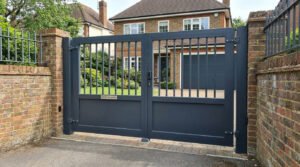
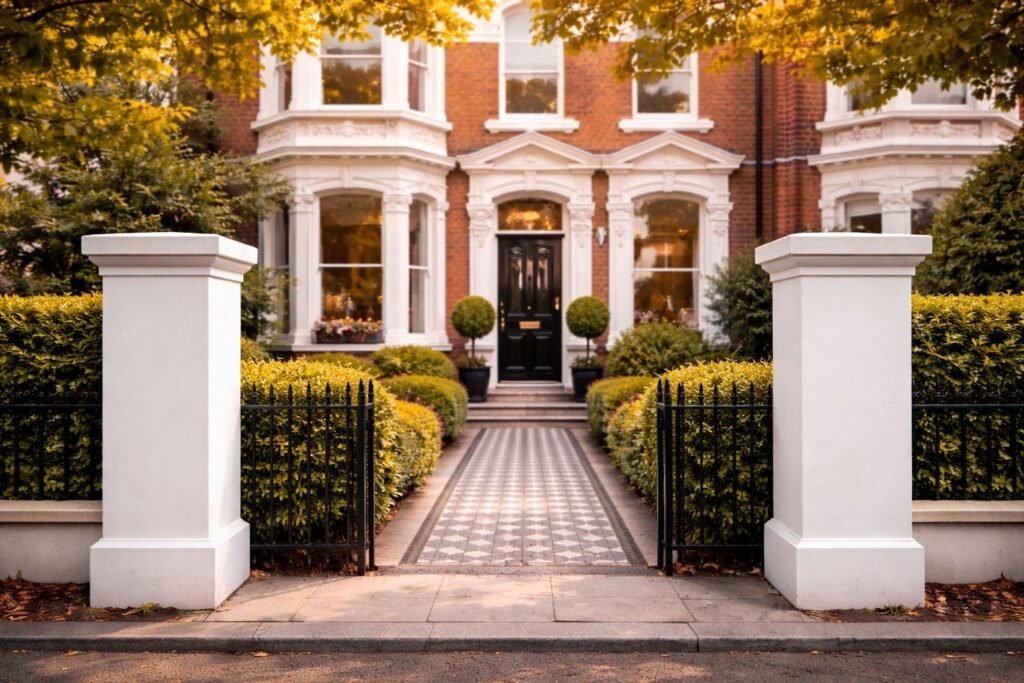
The passage between two terraced houses is one of the most overlooked vulnerabilities in London residential security. Side passages on Victorian and Edwardian terraces across Clapham, Tooting, Wimbledon, Wandsworth, and Putney provide direct access from the street to the rear of a property without going through the house. Unprotected, they are the route most commonly used for opportunistic access in urban areas according to Metropolitan Police crime prevention guidance.
A well-specified side gate closes that vulnerability with minimal disruption to the property and at a cost that is significantly lower than most front driveway gate installations. This guide covers everything a London homeowner needs to know about metal side gates in 2026: what they cost, how to specify them properly for a London terrace, what security features matter, and how to choose between a manual and electric option.
What Is a Side Gate?
A side gate is a single or double leaf gate fitted at the entrance to the passage between a property and its boundary wall or fence, typically between the front of the house and the rear garden. On most London Victorian and Edwardian terraces, this passage runs down the side of the house and connects the street frontage to the rear garden.
The term covers a range of products from a simple manually operated single-leaf gate to a fully automated electric gate with smart access control. What they have in common is that they are fitted in a narrower opening than a driveway gate, usually between 900 mm and 1,500 mm wide and they serve a specific security and access management function rather than a primarily decorative one.
Why Side Gates Matter More in London Than Elsewhere
London’s Victorian and Edwardian terraced housing stock is uniquely vulnerable at the side passage because of how it was built. These properties sit close together with shared or near-shared boundaries. The passages between them are narrow, partially concealed from the street, and on many streets they run all the way through to a rear alley or lane that itself provides access along a line of rear gardens.
In a rural or suburban setting, an unprotected side passage is less of a concern because natural surveillance from neighbours and passers-by is higher and the density of properties creates less opportunity for concealed movement. In the dense urban streets of South West London, the opposite is true. A passage that is invisible from the street for even a few seconds provides enough cover for an opportunist.
This is not a theoretical concern. The Metropolitan Police consistently identify unsecured side access as a factor in residential burglaries and vehicle theft from rear access properties. A robust side gate that cannot be easily climbed, forced, or lifted closes that access point permanently.
Side Gate Costs in London
Side gate costs in London vary considerably depending on the material, height, and whether the gate is manual or electric.
| Side Gate Type | Typical Installed Cost in London (2026) |
| Manual steel side gate (standard height, 900 to 1,200mm) | £600 to £1,200 |
| Manual steel side gate (tall, 1,800mm, anti-climb) | £900 to £1,800 |
| Electric single leaf side gate | £2,500 to £5,000 |
| Bespoke fabricated side gate (any height, custom design) | £1,200 to £3,500 |
These figures include supply, fabrication where relevant, and professional installation in London. They do not include any groundwork beyond standard post setting, which is usually minimal for a side gate installation on an existing passage.
National online prices for supply-only side gates start much lower £150 to £400 for a basic panel from a catalogue supplier. These prices are for the gate leaf only, without posts, hinges, locks, installation, or any fitting and the products are almost universally not suitable for the dimensions of most London Victorian terrace passages, which are irregular and often not plumb or level.
What Height Should a Side Gate Be?
This is the question most London homeowners get wrong, and it is important.
A standard 1,200mm (4 foot) gate provides boundary definition and a basic deterrent but can be scaled by a determined intruder in seconds. In a security context, this height is better than nothing but should not be described as secure.
A 1,800mm (6 foot) gate, matching the height of a standard close-boarded fence, is the minimum height that provides meaningful deterrent against casual climbing. It is also the maximum height for most permitted development installations in London anything above 2,000mm typically requires planning permission.
For properties where security is a genuine priority, 1,800mm with anti-climb features at the top is the right specification. Anti-climb features include spiked tops, rotating roller bars, or angled steel sections that prevent a foothold. These are legal and appropriate for residential security applications in London and are used regularly on side gates across SW postcodes.
For properties in conservation areas where a 1,800mm steel gate on the front elevation would not be appropriate visually, the solution is usually to position the gate further into the passage rather than at the street frontage, where it is not visible from the road and the height and security specifications can be optimized without any aesthetic compromise.
Manual vs Electric Side Gates
Most side gates in London are manually operated. The reason is practical the cost of adding automation to a side gate that may be used infrequently, or that serves primarily as a security barrier rather than a daily access point, often does not justify the additional investment.
Manual side gates should still have quality locking hardware. A deadbolt or heavy-duty padlock on the inside of the gate, combined with a self-closing hinge mechanism that prevents the gate being left accidentally open, is the standard specification for a security-focused manual side gate. A slam-shut self-locking mechanism is available on many side gate designs and is worth specifying for properties where the gate is used regularly but where automation is not warranted.
Electric side gates make sense in specific situations. If the side passage provides the primary access route for regular deliveries, where visitors frequently need to be let through without the homeowner coming to the gate, where the side gate provides access to a garage or parking area used daily, or where the homeowner wants integrated app control across all access points on the property, automation is worth the additional cost.
Automated side gates use the same motor systems as driveway gates articulated arm motors for single-leaf swing gates are the most common specification. The electrical requirements are the same and the safety compliance requirements under HSE guidelines for powered gate installations apply identically. All automated side gates must include photocells and safety edges.
Material and Design for London Side Gates
Steel is by far the most common and the most appropriate material for side gates on London Victorian and Edwardian terraces. A hot-dip galvanised mild steel gate, powder-coated in black or anthracite, suits the period architecture naturally, withstands the urban environment reliably, and maintains its appearance with no significant maintenance for years.
Timber side gates are available, and some homeowners prefer the visual warmth of wood for a garden-facing gate. The practical limitation in London is that timber gates in urban environments are exposed to pollution, variable moisture levels, and the shade of dense urban planting that accelerates deterioration. A timber side gate on a dense SW London terrace needs more maintenance than a steel one to maintain its appearance.
Aluminium is occasionally used for contemporary properties where weight is a consideration and the visual profile is modern. On a Victorian or Edwardian terrace it tends to look lightweight and out of character.
In terms of design, side gates on London terraces should match or complement the existing boundary treatment front garden railings, front gate, or boundary fence rather than being specified independently. A side gate that obviously does not belong to the same family of materials and finishes as the front boundary treatment creates a visual inconsistency that most London homeowners find dissatisfying once it is pointed out.
The Security Specification: What Actually Matters
For a side gate that is genuinely intended to improve security rather than just provide a boundary marker, several specific features matter.
Hinge specification. Standard lift-off hinges can be defeated by lifting the gate off the hinge pins from the outside. Security hinges include anti-lift pins that prevent the gate being separated from the post without cutting. This is worth specifying on any gate where security is a priority.
Lock position and type. A lock at mid-height on a tall gate provides much better resistance to forcing than a lock near the top. A deadbolt that engages into the gate post or a receiver embedded in the ground (for a double gate) is more secure than a surface-mounted bolt. For a padlocked gate, use a closed-shackle padlock that gives an attacker less to work with than an open-shackle design.
No-climb top treatment. On gates of 1,800mm and above, a security topper prevents the gate being used as a step to climb over. Rotating roller bars, welded spikes, or angled steel sections are all options. These should be visible from the outside deterrence is most of the function.
Gate rigidity. A gate that flexes significantly when pushed or pulled is easier to force than a rigid one. This is mostly a function of the frame section size and the quality of the welding. A 40mm box section frame is meaningfully more rigid than a 25mm frame on a tall gate.
Fixing quality. The gate posts need to be set in concrete to a sufficient depth and in the right ground conditions to be stable. A gate that looks secure but has posts that move in soft or clay-heavy ground is not secure. We assess this during every site survey.
Side Gates and Planning Permission in London
Most side gate installations in London fall under permitted development and do not require planning permission, provided the gate is below 2 metres in height. The same conservation area and Article 4 Direction rules that apply to driveway gates apply to side gates in areas where permitted development rights for front boundary changes have been removed, a side gate on the front elevation of the property may require a planning application.
For side gates positioned further back from the street frontage within the passage rather than at the road boundary the planning position is generally simpler, even in conservation areas, because the gate is not visible from the public highway.
For full guidance on the planning rules that apply to gates and boundary treatments in London, see our planning permission guide. For further national guidance, the UK planning portal sets out the permitted development thresholds.
Matching Your Side Gate to Your Front Boundary
One detail that makes a significant difference to how a property looks from the street is whether the side gate reads as part of the same boundary treatment as the front garden.
If the front boundary has steel front garden railings in black powder coat, the side gate should be steel, in the same colour, at a height that transitions sensibly from the railing height to the full passage gate height. If the front has a steel driveway gate, the side gate infill and finish should reference the same design rather than being a completely different product.
At NOVA Gates & Railings, when a project involves both a front gate or railing installation and a side gate, we design and fabricate both as a single coherent boundary package. The result is a property where everything at the front reads as having been considered together rather than assembled from different suppliers at different times.
About NOVA Gates & Railings
NOVA Gates & Railings is a CAME-approved bespoke metalwork company based in Wimbledon, designing and installing side gates, electric gates, swing gates, bespoke metal gates, and front garden railings for residential and commercial properties across London and South West London.
Every gate is fabricated in-house by our own team. We cover the full range of gates and railings across London.
Book a Free Site Survey
Call us on 020 7117 2642 or get in touch to arrange a free site survey.
We cover SW19, SW20, SW15, SW4, SW11, SW17, SW18, TW9, TW10, KT1, KT2, and surrounding areas.
NOVA Gates & Railings. Bespoke Gates, Railings and Side Gates. Wimbledon, London. CAME Approved. 10-Year Warranty.